

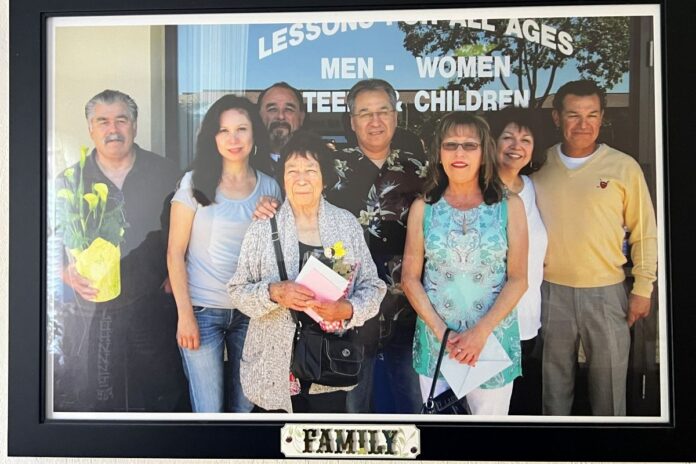
Carlos Farias was only five when he and his family would go out every weekend to work the fields, harvesting apricots, peaches and grapes from local orchards. “We’ve always been a close family,” he says.
The year was 1968, and his parents, Catalina and Manuel Farias, had just bought a home in Newark for $20,000. With wages running around $1.50–$2 per hour, they needed the extra income to support Carlos and his seven siblings.
Manuel passed away in 2016 at age 83, but Catalina is still alive, age 102, living in that same house with Carlos, now 63 and retired. “She’s on hospice, she can still move around, but she had a stroke a few years ago so now she can’t really communicate. It’s frustrating. So that’s why it’s important to me that she gets good care.”
At a March 26 Newark City Council meeting, Catalina received a special commendation from Mayor Michael Hannon as part of Women’s History Month. “When we have a resident who reaches 102 years of age, we’re going to recognize them,” he announced. “She’s been a proud resident of Newark for over 77 years. So she was here before Newark was even a city.”
Catalina has two sisters—Emma, age 101, who lives in the same neighborhood, and Jocoba, age 99. Her two brothers, Jesus and Raoul, have passed away. Born in Los Angeles in1924, Catalina (and her family) moved to the Almaden Valley during the Great Depression in the 1930s, then moved to Jalisco, Mexico, where she spent most of her childhood.
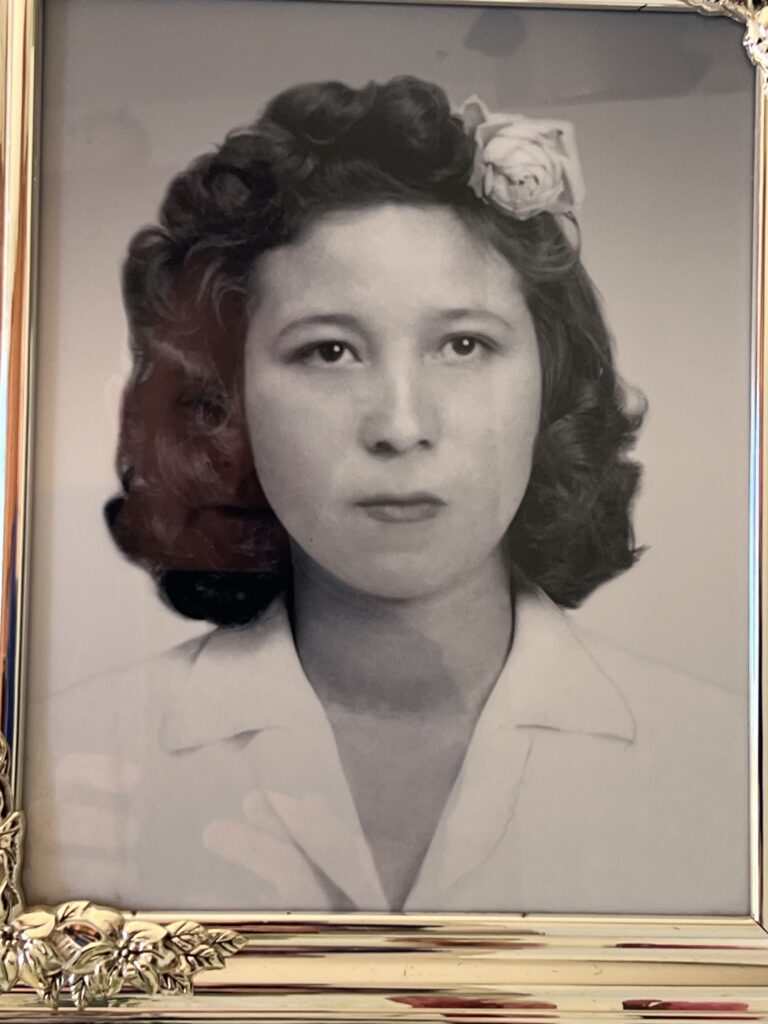
During World War II, Catalina’s family came back to the U.S. as part of the Bracero Program, a federal initiative to fill agricultural and railroad labor shortages by importing Mexican workers. Carlos’ grandfather (Catalina’s father), Teodosio, bought some land off Walnut Street in Newark and built two houses for the families. He also acted as supervising foreman for local laborers, housing them in the Knotty Pine Hotel and Bar with help from his friend, Jim Neves.
“Every morning he’d pull up in his flatbed truck and drop them off at local farms,” says Carlos. “This is how my mom met my dad. She would help punch the cards of the workers, which is how they got paid, you know, by the bucket, or the bushel. She worked the fields her whole life.”
Catalina helped grow tomatoes for the Pattersons near Coyote Hills, where they used natural irrigation from the bay. She worked for Joe Perry, and the Pianetta Brothers, John and Tino. In a time when orchards and farms were the main industry, she was there. And then she became a housewife and raised seven children.
“She’s a strong woman,” says Carlos. “She worked for Naka Nursery in Niles until she was 81. She was their top rose pruner.” He remembers her driving her 1979 Ford Thunderbird through Niles Canyon. “She loved that car.” A car she won through a scratcher drawing at Fry’s Food Stores.
Carlos also remembers her tortillas. “Before they were sold in the stores she used to make tortillas two times a day. She would handroll them in the kitchen and I would watch. And she’d ask me: Carlos, do you want a tortilla with butter? And I’d say, ‘Oh yes, of course!’”
Spanish was spoken in the home. Catalina never had the need to speak English and had never learned it in school. She understood it, and took English classes at night school while in her 60s. And while Carlos and his siblings are mostly bilingual, she would only use Spanish. “Now of course the great-grandkids all speak English,” says Carlos. “They don’t speak much Spanish.” Catalina has 11 grandchildren and 11 great-grandchildren.
Catalina’s parents were among the first parishioners of the original St. Edward Catholic Church located on Sycamore Street. When Catalina turned 100, the church had a mass in her honor where they all sang “Happy Birthday.”
“I was hoping for ‘Las Mañanitas,’ which is more romantic,” says Carlos. “But it was a nice moment.” When Catalina stopped attending church in person, they came to her. “Every Saturday they would come over to give her communion,” says Carlos. “That’s how much she means to them.”
Catalina’s green thumb is evident in her backyard garden, which is ripe with apple trees, peach trees, persimmons and strawberries. “This is her life,“ says Carlos. “I used to live on Locust Street, and she would come over when I wasn’t home and turn my flower beds, weed and water everything, and trim my roses. So when I got home my neighbor would say, ‘Hey Carlos, your mom was here. Man, she’s a hard worker.’ And I’d say, ‘Yeah, she’s embarrassing me!’”
Catalina Flores Faria: a remarkable woman whose enduring spirit and dedication help shine a light on Newark’s agricultural past.