

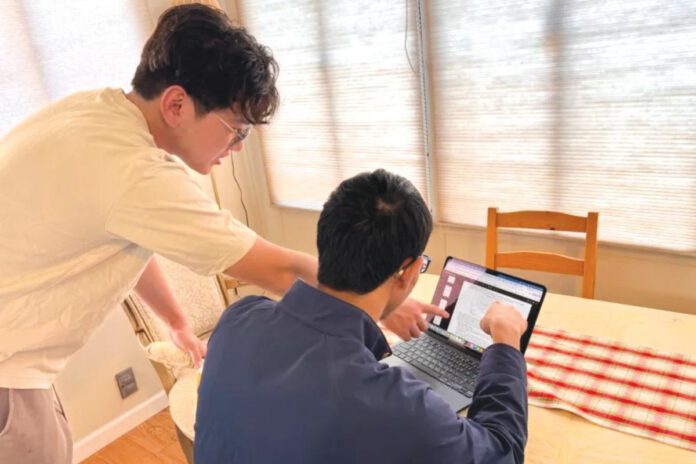
Schoolwork had been piling up on his desk alongside a history of code errors that had been toiling around in his mind.
Aditya Palit, the technical lead of his team, had been at his desk for hours applying mathematical models to datasets, slowly feeling frustrated.
“I thought it would take just 30 minutes,” the Mission San Jose High School (MSJHS) junior said. “But by the end of the day, it wasn’t even in a presentable state.”
Training the models took a long time to see results, with bugs or needed improvements only surfacing after hours of training. However, Palit was determined of the impact and potential the project had, using each setback as motivation.
Eight months later, he would stand on the national stage of the Modeling the Future Challenge (MTFC), a prestigious high-school competition that challenges students to apply mathematical modeling and risk management to tackle real world problems.
The MSJHS team of juniors, known as Kolmogorov Crew, which consisted of Palit, Captain Caleb Ma, Veer Mahajan, Aashrith Yedavalli, and Aditya Ojha, underwent rigorous learning and testing across three phrases of the challenge. They ultimately created a research paper that examined how climate-related conditions and autonomous vehicles could influence traffic safety, winning a third-place finish among over 440 contestants and $10,000 in prize money.
The first stage was a series of up to 30 different scenarios, gauging students’ ability to model data and analyze risk.
Despite Palit and Ma’s background in math olympiad, the first scenario’s questions required knowledge of actuarial science of which they had never learned before. The team used the majority of their time to learn more, studying programming languages like R, scouring resources and strategies provided by MTFC, and engaging in exhaustive conversations on the topic.
During this stage, they had also begun brainstorming for the second stage, a phase where students are required to write a research report on any topic.
“We wanted to do something with a real impact, especially in our community. So we started looking at climate [change],” said Ma. However, due to a lack of significant publicly available data that fit their project, they decided to expand to include traffic safety.
“Traditionally most people just analyze traffic risk as an individual problem and climate as an individual problem,” said Ma. “We wanted to really analyze the intersection of the two, especially when autonomous vehicles come into play as well.”
After they passed the first stage, they worked extensively on their research paper in the second round. They sought to understand whether autonomous vehicles could improve road safety enough to offset the increased risks posed by climate change, such as extreme heat.
To answer this, they analyzed 7.7 million collision records and applied six predictive models and various algorithms. Their findings suggested that, under most projected scenarios, autonomous vehicles would offset the increased crash risk associated with climate change, except under extreme climate.
Their research allowed them to be one of 15 teams to advance to the final stage, requiring applicants to create a video and be interviewed by professionals about their work. “We spent a lot of time on the video because it’s a 15 minute video, so you have to come up with a script, record it, and edit it—it takes forever,” said Ma.
Through teammates Mahajan helping to write out the math section and plan out the video and Ojha editing the video, the team’s final effort proved successful as they placed third overall.
“The team aspect really made this huge project much more manageable, and working with such talented peers gives me hope for the future,” said Mahajan.
For Ma, the competition has inspired him to pursue quantitative sciences in the future. “I originally wanted to go in a pure math direction, but [the competition] really changed that and now I’m a lot more interested in the ML direction and I might even want to become an actuary,” said Ma.
Just as he learned through the most frustrating parts of the competition, Palit said, “If you have a passion for a problem, you can really go far and do something pretty cool.”