

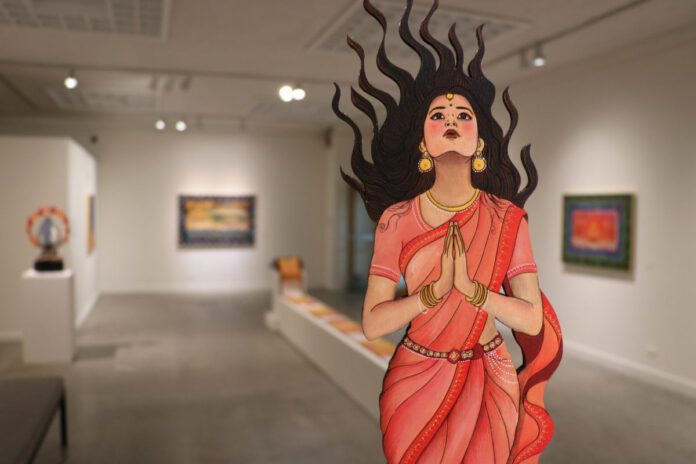
When Pragati Sharma Mohanty was a little girl growing up in India, the nation was riveted to a television show telling the epic tale of the Ramayana. But as an adult, she said in a phone interview, she realized how much more complex the original text is. She investigated 15 ancient versions of the story of Rama, who is the seventh avatar of the god Vishnu, his wife Sita, his brother Lakshmana and Sita’s kidnapper, Ravana.
Then, in 2020, she began the series of paintings and sculptures in her Sunnyvale studio that are now featured in “Daughter of the Earth,” a current exhibition at the Richmond Art Center (RAC). “It was the right time,” she said. “There are so many aspects of the story many people don’t know. I took it up as a challenge.”
Curator Amy Spencer, who is also the RAC’s community engagement director, visited Sharma Mohanty’s studio and found it wall-to-wall with images, all telling stories from the Ramayana, and all created in her intricate “maximalist/miniaturist” style. “She works on multiple paintings at the same time, all interconnected,” said Spencer.
Sharma Mohanty trained in architecture and design, and her technique for her paintings, she explained, evolved as she wanted to layer watercolor/gouache images on top of acrylic backgrounds, also using laser-cut figures on rice paper “collaged” into and onto the piece. “Her technique is traditional—up to a point,” said Spencer. “But she wanted to take it further. There is a lot of detail and repeated motifs.”
In some ways, using the cutouts in their repeated and different poses, “is a lot like creating [stop-motion] animation,” said the artist.
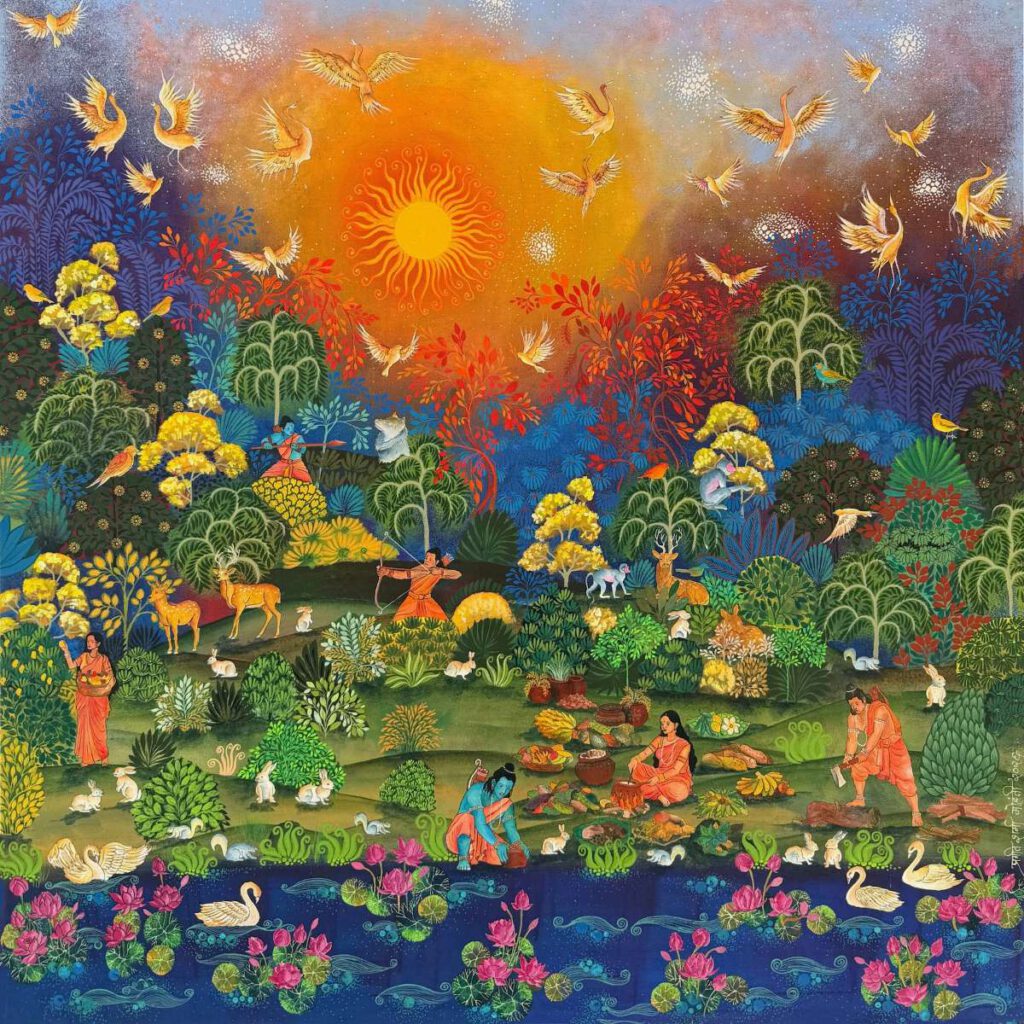
Viewing the immensely meticulous paintings, multiple stories, motifs and symbols are revealed in each one. And, as the exhibition’s title indicates, much of the focus is on Sita, who was not born by a human mother, but discovered in a furrow in a field, making her a “daughter of the Earth.”
After marriage to Rama, she follows him into banishment in the forest, where she is abducted by the demon king Ravana, until rescued by Rama and commander of the monkey army Hanuman.
But when rescued, Sita’s fidelity is questioned and she undergoes trial by fire to prove her purity. Yet even this is not enough, and when later, she is asked to repeat the ritual, she chooses instead to return to the Earth.
“Sita is a heroine,” said Sharma Mohanty. “She makes her own choices.” In one of the exhibition’s sculptures, viewers find themselves looking in a mirror. “Every person has to go through tests, coming out of them as a new person,” said the artist.
‘We assume that most people will not be familiar with the Ramayana. Even those who are will likely enjoy hearing the artist’s own interpretations of her work.’
– Curator Amy Spencer
Spencer noted that Sharma Mohanty recorded video narratives about the pieces, which can be used as an audio tour as people view the exhibition. “We assume that most people will not be familiar with the Ramayana. Even those who are will likely enjoy hearing the artist’s own interpretations of her work,” said Spencer.
Yet another way in which those new to the text can explore it is with a 70-foot-long scroll that contains the entire Ramayana, nearly 24,000 verses, divided into seven chapters. Each verse is a couplet, two individual lines. A crank system allows the scroll to be turned to show new parts of the text. “It’s another interactive element,” said Spencer.
Sharma Mohanty has also established a teaching facility in her Sunnyvale studio, the Pragati Art School. Since moving to the Bay Area from the East Coast in 2014, she discovered that residents were, in her words, “more open to learning about other art forms.”
Now, with the help of two studio assistants, she teaches multiple forms of traditional Indian arts, representing every state in India, alongside other cultures’ folk art styles. Indian forms include mandala painting, paper cutting and painted textile art.
Classes are small, six to eight students, and adults-only.
Circling back to “Daughter of the Earth,” both Spencer and Sharma Mohanty suggest taking time to examine and contemplate the intricate images. “Read and listen to the narratives. Use your eyes,” said Spencer. “Enjoy the stirring panoply of the works.”
The artist has found early reactions to the exhibit heartwarming. “I am so overwhelmed by the response,” she said. “I’m very excited that people connect so deeply with the work.”
She is also working on compiling a coffee-table book of the images, available in 2027.
For more information about the Pragati Art School, visit pragatisharma.com/about-1.
Daughter of the Earth
Through Aug. 15, Wed-Sat
Gallery hours: 10am-4pm
Richmond Art Center
South Gallery, 2540 Barrett Ave., Richmond
510.620.6772
richmondartcenter.org
Free