

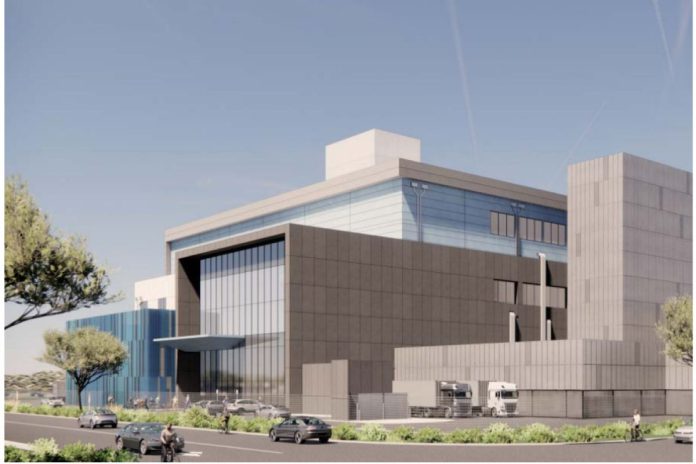
Across the country, data centers have become flashpoints in debates over energy use, water consumption, tax incentives and local control. Hayward is no exception.
The Stack Infrastructure data center became one of Hayward’s most controversial recent developments, raising questions about energy use, oversight and how major projects move through city approval processes.
Over the past two years, the Hayward Herald has tracked the data center as it moved through the city’s approval process. The project offers a revealing look at how local government works in Hayward and raises questions about zoning, business classifications, public benefits and community oversight.
At the center of the controversy is a simple question. How did a 300,000-square-foot facility, standing 100 feet tall, move forward without city council oversight or approval?
The project first came under public scrutiny in 2024 as it moved through the city’s planning process. While the developer negotiated a Public Benefits Package in exchange for exceeding the city’s height limit, the project did not require city council approval.
The planning commission’s pivot
By November 2024, the proposed Public Benefits Package had increased to $1.3 million. Planning staff recommended consolidating benefits, including solar panels at the Water Resource Recovery Facility, a bike path serving Eden Gateway and funds managed by the Hayward Area Shoreline Planning Agency.
Commissioners questioned the size and purpose of the benefits package, as well as the project’s environmental impacts, including its energy use and backup generators. Some questioned whether the commission should be negotiating public benefits at all.
Escalation and approval
In May 2025, the Hayward Herald continued its coverage of the Stack Infrastructure project as the planning commissioners pressed the developer on several aspects of the proposal. Commissioners also questioned the company’s environmental claims and energy strategy.
The project drew strong support from organized labor, which highlighted commitments to 100% union labor and an estimated 380 temporary construction jobs. The facility is expected to create 41 permanent on-site positions.
Following the hearing, the planning commission approved Stack Infrastructure’s request for an additional eight feet of building height, in exchange for a $2 million Public Benefits Package, a $500,000 increase from the previous proposal. The agreement also included replacing a water main, a commitment presented as a public benefit despite the facility’s substantial water demands.
Despite repeatedly criticizing the benefits package during the discussion, planning commissioner Robert Stevens ultimately made the motion to approve the height increase. The planning commission voted unanimously in favor of the project.
The classification loophole
By January 2026, attention shifted to the city’s zoning code. During a planning commission discussion, members agreed that existing regulations were too restrictive. Stevens argued that limiting data centers to general industrial districts constrained the city’s ability to adapt to future economic trends.
The discussion also shed light on how the Stack Infrastructure project moved through the approval process. Although data centers were permitted only in general industrial districts, they were categorized as office uses under the city’s code. That allowed them to move through the standard planning process without input from anyone but city staff.
The project came before the planning commission only because the developer requested an especially tall building. Once that request was made, the commission, not the city council, became the body responsible for approving the project and negotiating the final Public Benefits Package.
By the time broader concerns reached the city council, key approvals had already been granted.
City council’s wake-up call
In January 2026, the city council publicly confronted the implications of the planning commission’s earlier approvals. Council members George Syrop and Angela Andrews raised concerns about the project’s demand on the city’s power and water infrastructure. “One-fifth of all homes in Hayward. That amount of electricity is going to be used by this singular data center,” Syrop said, questioning whether the city had adequately evaluated the value of the Public Benefits Package compared with agreements negotiated in cities like San Jose.
Several council members also questioned whether projects of this magnitude should continue to bypass direct council review. The discussion marked a shift from debating the merits of a single project to reconsidering how future data centers should be approved.
Council members agreed that projects of this scale should receive greater public oversight. Going forward, all data center projects will require full city council approval.
A lesson in local governance
The controversy was not the result of a secret vote or a backroom deal. It was the result of a complex planning process that few residents were following.
The project illustrates why local government decisions often happen long before a final vote. Understanding zoning rules, planning commissions and approval processes is essential for residents who want to shape their communities.
That is why local journalism matters. For the past two years, the Hayward Herald has followed this project from its earliest reviews through the public debate that continues today. We remain the only nonprofit newsroom in Hayward covering city hall meetings twice each week.
Read the article in its entirety at HaywardHerald.org. For continued coverage of Hayward’s local government and development, consider becoming a paid subscriber of Hayward Herald.



I am horrified to be hearing of this for the first time. I was a long time Hayward resident, now residing in Oakland, and I am a daily subscriber to the SF Chronicle. I have not followed the Hayward Herald but it obviously provides a vital service. Apparently the San Jose Mercury did cover some of this and I would have hoped that the Chronicle would have picked up the story from the Herald and tracked it closely. Indeed, local journalism is in trouble. This is certainly a matter that if local leaders had learned of earlier, more could have been done to delay or even prevent it. Obviously this is a very controversial issue around the country and I would have hoped that the SF Bay Area would have been on top of it. Thank you for your dogged coverage and please advise me how much of the east bay area you cover. gail bunker