

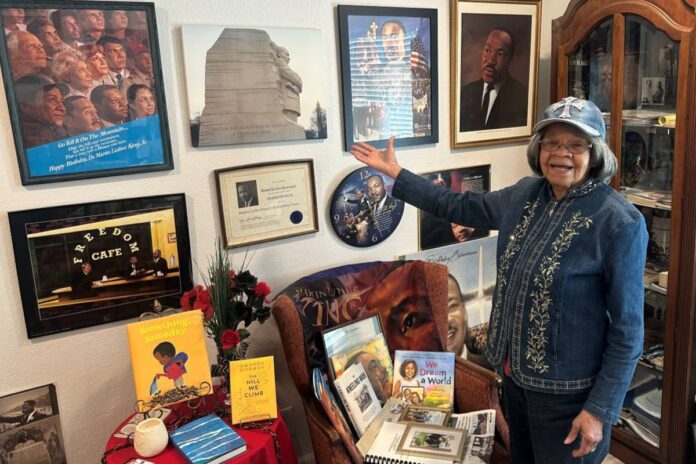
Few individuals know the City of Newark as intimately as longtime resident Jean P. Ficklin. At 95 years young, Ficklin has become a beloved and recognizable figure in the community. Often described as the elegant woman with a perfectly coordinated hat and outfit, she is admired not only for her signature style, but for the extraordinary life and legacy she has built over decades of service and leadership in Newark.
Born in Mississippi in 1931, Ficklin spent her early years in the South during a pivotal period in American history. She recounted how in the early 1960s, she was denied voting when several Jackson, Mississippi Police officers blocked her entry into the voting station. On her third attempt, she was finally granted entrance to the building, only to meet another barrier: a forced eligibility test and three dollar poll tax fee.
In December 1963, Ficklin’s life took a turn when her husband accepted a position with Lockheed Martin in the Bay Area. Although the family initially planned to settle in Hayward, a change in circumstances led them to Newark—at the time a small and still-developing community.
Upon their arrival, the first person to speak to her husband was the pastor of the First Presbyterian Church of Newark. He invited them to his church, and the following week, Ficklin joined the choir. To this day, Ficklin remembers how she was openly accepted, and she has attended weekly services at this same church for the last 60 years.
While Newark was considered more progressive than many parts of the country, the Ficklin children still experienced racial discrimination in school. Over time an increasing number of African-American families moved to the area. This growing diversity helped foster a stronger sense of belonging for the Ficklins.
In September 1964, Ficklin accepted a position as a first-grade teacher, making history as the first African-American teacher in the Newark Unified School District. Though initially nervous, she found the district to be welcoming and supportive, and thrived in her role as an educator.
As Newark grew, Ficklin recognized the importance of civic engagement. She was appointed by Newark’s first mayor, James Balentine, to serve as a commissioner on social concerns, where she worked to address community needs and build connections across diverse populations.
Motivated by a desire to celebrate Newark’s cultural diversity, Ficklin helped organize events highlighting Native American, Irish, Mexican and Chinese heritage. This passion led her to found the Afro-American Cultural & Historical Society in 1974. The organization continues to support education initiatives, civic engagement, human services and cultural awareness.
Despite her many municipal accomplishments, Ficklin considers education to be her greatest passion. She retired in 1987 after a distinguished career spanning decades. Reflecting on her final year in the classroom, she fondly recalls her last class being a combination of young students from 17 different cultural backgrounds, including one from Yemen—a testament to the diversity she so deeply valued.
Ficklin remains a proud and devoted member of the Newark community. She speaks with gratitude about the support she has received, including from the city’s leadership and all four Newark mayors over the years.
As she looks to the future, she hopes to continue inspiring others and leaving a lasting legacy—one rooted in unity, inclusion and compassion for all, regardless of background, gender, race or even personal style.
For more information about the Afro-American Cultural & Historical Society, visit aachstricity.org.