


On April 30, Milpitas Community Center held a commemoration for Black April, the 51st anniversary of the event that marked the end of the Vietnam War. The atmosphere was a mix of celebration and mourning.
April 30 is a significant day for many Vietnamese refugees and Vietnamese Americans. Also known as the “Fall of Saigon,” the day the South Vietnamese Army officially surrendered to North Vietnam at the South Vietnamese Capital Saigon is seen as a day of mourning and perseverance.
Veterans shared their memories of that day over 50 years ago. Van, a South Vietnamese Marine veteran, said he left Vietnam by boat and ended up here. He said he’s thankful to live in a country where he feels free.
Lac Bui, a South Vietnam war veteran, said he is also one of the people who left Vietnam in 1975. An attendee volunteered to roughly translate what Bui said in Vietnamese. Bui said he still remembers the thousands of Vietnamese people who lost their lives during their journey to freedom.
The keynote speaker was Angelie Do, a Milpitas pharmacist and community volunteer. “I’m here as a child of Vietnam, one who deeply loved our roots, and carried the boundless appreciation for the resilience of our overseas Vietnamese community,” she said.
“I speak from the depth of my soul about what Black April, the 30th, means to me,” Do continued. “My journey of community service began in 2011. Back then, my only wishes were to use my fluency in English and Vietnamese to serve our people. But the more I emerge myself in this community, the more I realize a beautiful truth. I receive far more than I give.”
‘Whenever the statistics of the fall of Saigon are mentioned, the two million who fled, and hundreds of thousands whose lives have ended beneath the way of the Pacific, the world sees numbers. But to me, these are not only statistics. These are my own flesh and blood.’
– Angelie Do
She said the more she volunteered, she slowly learned about her own history, about her people escaping Saigon in Vietnam by boat.
“My family story is woven into the same convergence,” said Do. “I came to California in 2000. In those early years, we rarely saw each other. Everyone here worked two, three, four jobs. Totaling 12 or more hours a day, they sacrificed their own rest so that my generation can go to school, pursue the American dream.
“Whenever the statistics of the fall of Saigon are mentioned,” added Do, “the two million who fled, and hundreds of thousands whose lives have ended beneath the way of the Pacific, the world sees numbers. But to me, these are not only statistics. These are my own flesh and blood.
“No one can truly measure the agony of the boat people unless they walk that path themselves,” Do said. “Their bones rest beneath the waves so that we could stand on this ground. This is our Vietnamese story. A tragic, heroic, but eternal legacy of the Vietnamese abroad.”
After her speech, a South Vietnam veteran stood at the podium to put a hand to his chest as the Vietnam national anthem played. Do joined him and passionately sang along.
Light appetizers and refreshments were served, including Vietnamese spring rolls and a sweet sticky rice dessert called Che Dau Trang.
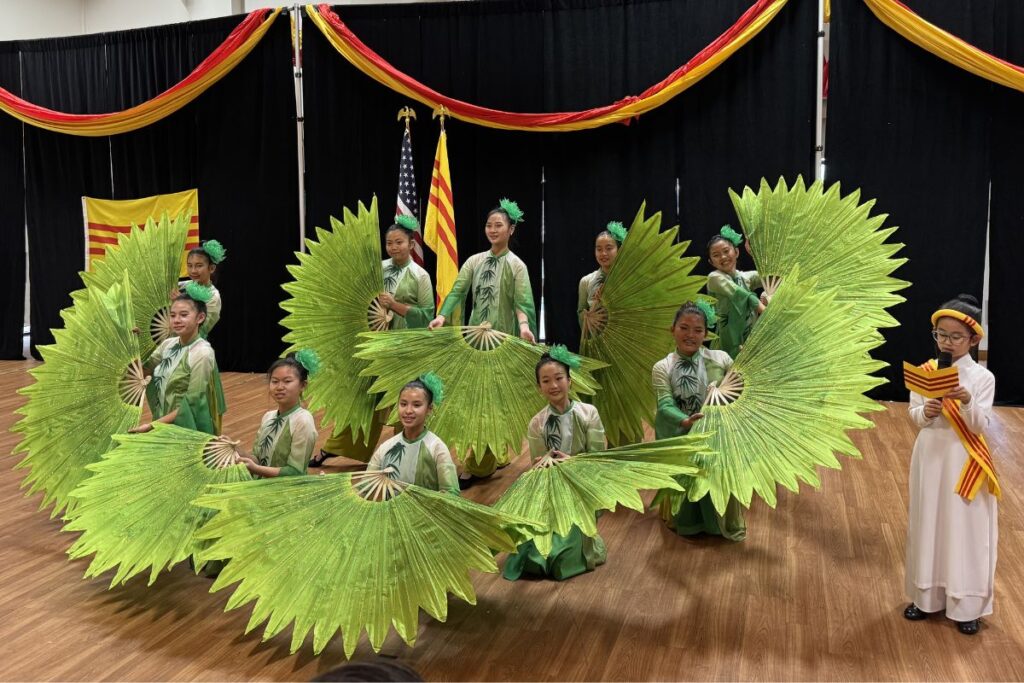
A group of girls performed several Vietnamese cultural dances as guests enjoyed their food. A small girl gave a brief description of the dances and their meaning. She described the first performance as a heartfelt tribute to expressing gratitude and remembrance. It honors the sacrifices of those who came before us, hearing the message of love and resilience.
After the performances attendees took a candle and stepped outside at a stage area in front of the poles flying American and Vietnamese flags for a flag raising ceremony. Despite a windy evening, most people were able to light their candle and keep it lit for most of the ceremony.
The closing speech about Black April was made by Milpitas Councilmember Hon Lien. “For some, it was the end of a war. For many others, it was the beginning of loss, separation and an uncertain future. Families were torn apart, lives were left behind. People risked everything, crossing oceans, facing danger, just for a chance to live freely,” she said.
“For those who became refugees, democracy was no longer something abstract. It became something real, something worth sacrificing for, rebuilding for and protecting for the next generation.”