

On Sept. 11, 2001, a United Airlines plane bound for San Francisco was hijacked by terrorists, who most likely intended to crash the plane into the U.S. Capitol. Passengers and flight attendants of Flight 93 fought back and heroically diverted the plane—preventing an even greater tragedy. The plane crashed in an empty field near Shanksville, Pennsylvania, killing all 40 people aboard.
Union City was the first city to create a memorial specifically honoring the passengers and crew of Flight 93 and the first to establish a memorial commemorating the events of 9/11. Dedicated on Dec. 8, 2007, the memorial stands in Sugar Mill Park, flanked by tall trees and rose bushes.
Union City Mayor Gary Singh officiated the 25th anniversary commemoration, which included a speech by Michael L. Emerson, who envisioned the memorial and led the effort to bring it to life. The ceremony also featured music by the Dunvegan Bagpipe Band, a military gun salute and the reading of the names of all the heroes aboard Flight 93. It concluded with the playing of Taps. Among those in attendance were family members of the victims.
Emerson, a retired Marine and Desert Storm veteran, lived in Hayward at the time of the 9/11 attacks. He was deeply moved by the story of the passengers and crew who fought back against the hijackers. The following Fourth of July, Emerson flew to ground zero to show his support and was surprised that none of the people he spoke with mentioned Flight 93.
“At the time, a lot of people didn’t know about the heroism, how they fought back. The movie helped with that. But a lot of people then didn’t know,” said Emerson. “But what it did was it steeled resolve in me that since they’re not talking about building a memorial to honor these heroes of Flight 93, I wanted to do something in the Bay Area near where I lived.”
Emerson felt that the Bay Area should have a place to honor the passengers and crew whose lives ended on a plane originally bound for San Francisco—many of whom lived, worked or had grown up in the Bay Area.
In 2002, Emerson began working with local government officials to create a memorial honoring the heroes of Flight 93. Union City offered a site, and the project became largely a community volunteer effort. Materials, labor and funding were donated, and the memorial took five years to complete.
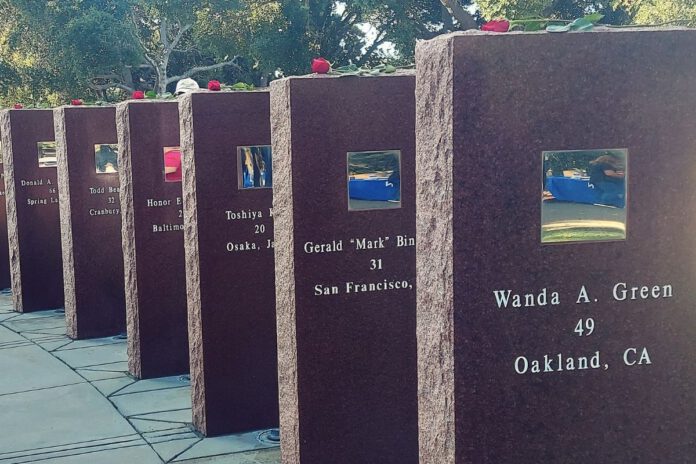
The 40 commemorative marble stones serve as individual memorials to the 40 passengers and crew members aboard Flight 93, bearing each person’s name, age and hometown. Emerson co-designed the stones with symbolic meaning. The polished front surfaces contain stainless steel mirrors, so visitors see themselves reflected alongside the name of a victim, a reminder that it could have been any one of us. The backs are intentionally left unfinished, representing the unfinished lives of the victims.
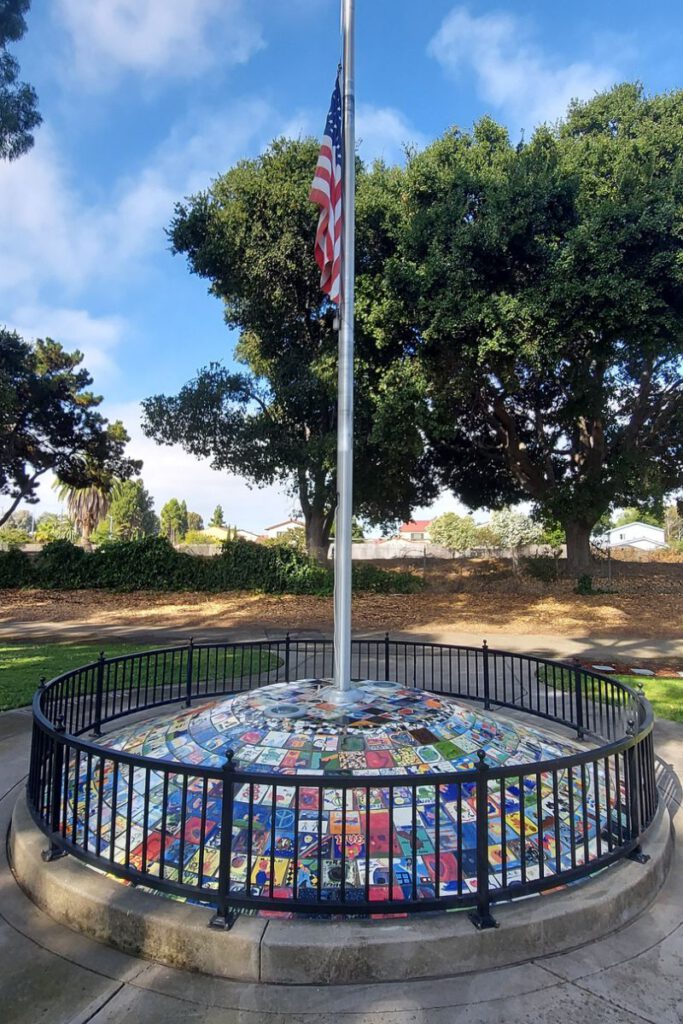
After visitors pass the 40 stones, the path ends at the Circle of Hope, where the memorial makes an intentional emotional shift. In its center is an American flag, representing the courage and sacrifice of the passengers and crew. Surrounding the flag are hand-painted tiles made by local children. The children were asked to create their own visions of the future, so the final part of the memorial moves away from the tragedy toward life, children and the future.
Every five years, the memorial holds a commemoration to honor the lives lost aboard Flight 93. As part of the ceremony, the American flag that has flown over the Circle of Hope is retired and presented to a family member of one of the victims as a keepsake connecting the memorial to those who lost loved ones on Flight 93. This year Emerson presented the flag to Air Force Colonel Frank Jamerson who is the nephew of Wanda Green, one of the flight attendants on Flight 93.
Emerson has since helped design many other memorials around the country including the National Flight 93 memorial in Shanksville, PA; the 9/11 memorial in Hayward and the veterans memorial in Castro Valley. He was deservedly described as the Monument Man in an article written about him by the American Legion.