
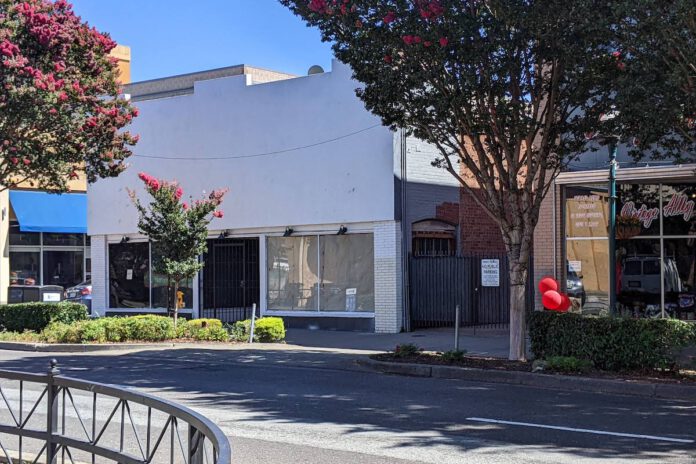
It’s unusual to see one place described as an economic powerhouse and an eyesore, but for many people from Hayward, downtown is an uneven experience. With great restaurants, multiple bars, a bookstore and more coffee shops than a reasonable person would expect, it’s the most walkable and vibrant place in the city. At the same time, it’s sprinkled with vacant lots, empty buildings, broken widows and surrounded by a circular freeway.
There’s more than one reason for the state of Downtown Hayward, from bad infrastructure decisions to problematic landlords to state and local laws getting in the way—it’s not an easy fix. But plans are in the works to make it better. So let’s look at some of the issues ailing Downtown Hayward, what’s being done about them and how that may improve things in the future.
A 20-year-old problem
CalTrans has spent decades trying to run another freeway through Hayward. The failure of the Route 238 extension through the Hayward foothills was a temporary setback that led to what is commonly known as The Loop. The 2007 city council landed on a circular pattern of one-way streets from four to six lanes wide surrounding the downtown core. The idea was to alleviate traffic on Interstates 880, 580 and 238 by improving speeds when cutting through Hayward.
Despite winning multiple awards, and coming in under budget, the project never lived up to its promise to improve traffic and revitalize downtown. Induced demand, which posits that traffic will always increase to fill available lanes, has proven true along a number of streets that connect 880 to 580. Collisions have occurred every 11 days, on average, since it was completed in 2013 and 1.5 people per year, on average, were killed or injured every year between 2013 and 2022.
The wide streets have made downtown less walkable and have functionally cut off the downtown core from the rest of the city. It now feels like an island in the middle of an asphalt sea, but that isn’t the only problem.
Nobody likes an empty building
Empty storefronts can happen for a number of reasons: absentee landlords, high retrofit costs and more—the issue varies from building to building. There are some properties that only exist in the investment portfolio of someone in another city who doesn’t care about renting it out—it increases in value regardless. City staff have tried to engage with them and get the buildings occupied, but some just don’t care.
Others require retrofitting to meet modern safety standards. The commercial buildings downtown are some of the oldest in the city, and many don’t meet earthquake safety standards. City staff has pointed out multiple times that landlords tend to push those costs onto prospective tenants. It’s the equivalent of looking at an apartment and the landlord saying that you need to pay for upgrades on the unit before you move in.
And if a tenant wants to open a restaurant—very popular downtown—the tenant needs to front the cost of installing a commercial kitchen in a building they don’t own. This can cost tens of thousands of dollars in equipment which may be stuck with the building. This is on top of the cost of any permits and licenses they need.
A complicated problem
None of this is news to City Hall. City staff have changed zoning and permitting requirements to make it easier to operate different businesses, they’ve developed a plan to undo The Loop, and there’s talk of potentially penalizing absentee landlords with a vacancy tax. Mayor Mark Salinas even went so far as to question whether old buildings need to be torn down and rebuilt for the sake of the business environment. But there is no silver bullet.
Staff hopes that this will improve traffic and walkability, make it easier to start a new business, and fill some empty storefronts and lots. But none of it is guaranteed. Businesses are going to leave, rule changes take time to be effective and changing the Loop will definitely take years to happen—assuming they ever get the funding.
But downtown is always changing. A decade ago, most of the storefronts were antique shops. An ethnic grocery store opened up, and multiple non-food or massage-related businesses are cropping up. In this economy, it’ll be up to us to invest in our own community and give them the support they need to thrive.