
A sales tax will be put in front of voters in five Bay Area counties this November to fund the Bay Area Rapid Transit system (BART).
Senate Bill 63 was passed in order to place the ballot question in Alameda, Contra Costa, Santa Clara, San Mateo and San Francisco counties. The sales tax is 0.5% in all counties except for San Francisco, which would have a 1% sales tax.
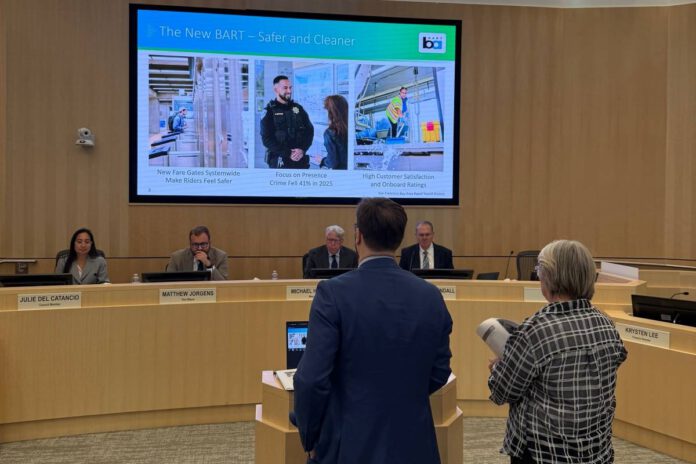
BART director Liz Ames and BART local government and community relations manager Bradley Dunn led a presentation on the transit system’s updates at the Newark City Council meeting on June 25. Updates included secure faregates, credit card readers and cleaner and safer stations with increased BART police presence.
Ames’ district represents Union City and parts of Newark, Fremont and Hayward. “You see more people out there in the stations, the police officers are out there,” she said. “I think people feel a lot safer taking BART now, and it’s cleaner. We’re seeing the results that people like to take transit.”
Ames said that BART is great for the ongoing World Cup matches and watch parties happening all over the Bay Area. BART is currently supporting the events with longer trains, additional security and late-night express trains.
Despite all the positive news, Ames said BART has a $375 million deficit. She said if the transportation sales tax measure passes, BART would receive $310 million in revenue per year starting in 2028.
But, more cuts would still need to be made to close the budget gap. “The money would be flowing in, but not enough to sustain this gap that we’re facing for this fiscal year,” Ames said.
If the ballot measure passes, BART plans to use a state loan to keep BART running as is without any cuts to service.
Dunn said remote work during the pandemic has changed how residents travel through the Bay Area. BART’s Clipper Card data show that people are taking one to two trips less per week.
Dunn also said overall, BART operating costs are expensive. “There isn’t a way to cut operating expenses without disproportionate service reductions. And we know that if there are really significant service reductions that also puts our revenue at risk, that thing that we depend on for most of our funding, as people say this system is no longer easy, convenient, safe and reliable.”
The worst case scenario would be 70% BART service reductions if the ballot measure does not pass. Ames said that includes 15 station closures and a three line service with less frequent BART trains. The stations would also close for the day at 9pm. About 1,200 employees would be laid off, which would affect police presence and station cleanliness.
Former Fremont Mayor Lily Mei said BART would be “pulling the rug” under people that live in the Bay Area if station closures happen.
“If we’re building things like transit-oriented development, which I’ve shared with all of you many times,” said Mei, “it’s hard for us to build 5,000 units of housing, a new school, a new hospital and all these other things, and then be told that we might shut down the BART station.”
Transit-oriented development around the Fremont BART station is being planned.
Newark Mayor Michael Hannon said he’s concerned about the message BART is trying to send when it comes to the ballot measure. “Everybody recognizes the importance of transportation and the value the transportation brings to a community,” he said. “I don’t think anybody up here would disagree with that. I think you’re going to go a long way further in terms of talking about the positives versus the negatives in terms of closures and this and that. Most voters don’t want to hear the negative. They want to hear the positive.”