

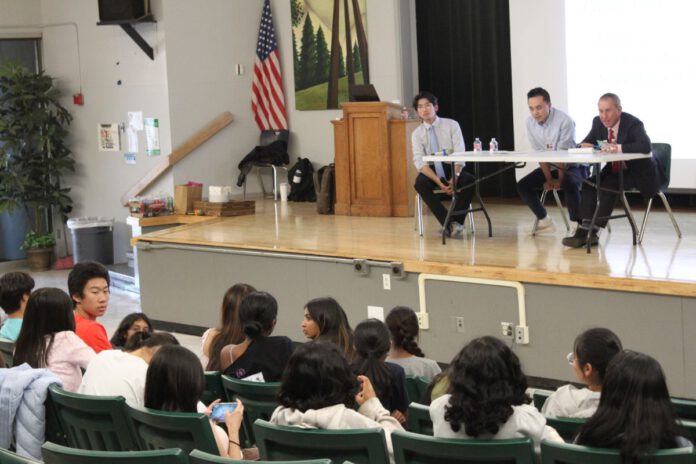
On Oct. 15, 2026, Rebuild the Bay hosted its first Housing & Policy Fireside Chat at Mission San José High School (MSJ), featuring Assemblymember Alex Lee and former State Senator Bob Wieckowski. Executive director Cham Yu organized and moderated the panel, which was co-sponsored by YIMBY Action and Fremont for Everyone. More than 70 students from MSJ DECA, MSJ Mock Trial and MSJ Model UN attended. Questions covered housing, legislative power, youth advocacy, artificial intelligence and transit.
On housing, Lee argued that land-use policy determines who can afford to live in a community. The average home in his zip code costs $1.7 million, he said, and the reason is restrictive policy, not oversized houses.
Wieckowski compared getting an affordable unit to winning the lottery: there are too few units for the demand, and cities and nonprofits compete for the same limited funds. His example was Project Homekey, the state’s motel-conversion program. County rules require any city that buys a motel to share its units with the whole county, so no single city has a reason to buy.
Asked which issues are hardest to address, Lee named anything that challenges concentrated wealth. He cited his work on a billionaire tax, corporate tax rates and renter protections. Wieckowski described the legislature as a family that fights over money, recalling battles over how to spend cap-and-trade climate funds.
Both urged students to engage directly. Lee stressed that every voice carries equal weight. He noted that 18-to-34-year-olds are the largest age group in his district but turn out to vote the least. He added that a Fremont high schooler’s bill idea on pediatric brain cancer became law within six months. Wieckowski advised students to visit officials in small groups, divide up their arguments and speak during public comment at council and school board meetings.
On AI, Lee said he had changed his positions on classroom phone bans and data centers as the technology and public opinion shifted. He warned that California is behind on regulation, that the governor has vetoed data center bills, and that federal interference threatens state action.
Wieckowski serves on the Unemployment Insurance Appeals Board. He cited Daron Acemoglu’s research on keeping displaced workers employed and Bill Gates’s proposal to tax automation. He framed regulation as guardrails rather than a halt to innovation. Both expressed concern about AI’s risks while acknowledging benefits, such as helping people who represent themselves in court.
On transit, both called for treating it as a public good funded by progressive taxes rather than fares. Wieckowski also criticized the fragmentation of the Bay Area’s 27 transit agencies.
In the open Q&A, students asked about: bills affecting youth, the climate effects of housing built near transit, why AI development continues despite its dangers, the age-verification law AB 1043 and AI tutors.
Lee closed by arguing that society should invest in human teachers rather than replace people with machines.
The panel is designed to be a first-of-many opportunity for students in the Fremont area to engage with policymakers and learn to advocate for their community. It seeks to strengthen students’ confidence in public speaking and expand their knowledge about the world through policy, including on housing, AI and other issues pertinent to the Fremont community.