

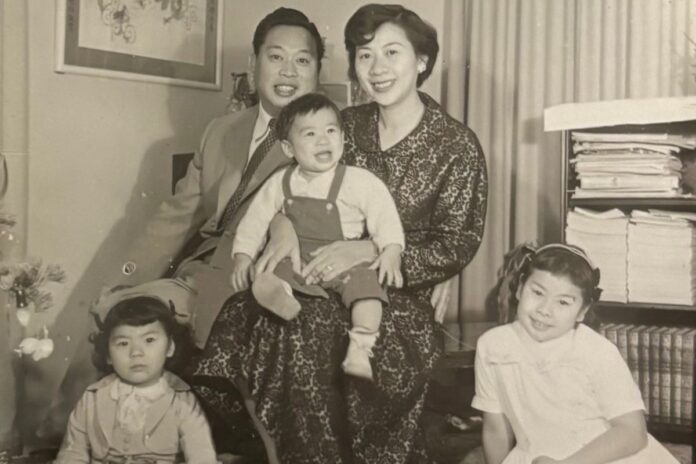
The story of the Moy and Mar families is a quintessential American journey—one defined by adjustment, hardship, and ultimate perseverance. While Guy Moy, a fifth-generation Chinese American resident of Fremont, has lost direct ties with China, his family’s rich California history serves as a testament to the strength of ancestors who navigated a changing nation. Today Guy’s grandchildren represent the seventh generation of their family in America.
The family’s American story began in the 1850s, when the Mars arrived in California, among the earliest Chinese immigrants. The Mars played a foundational role in the development of the Monterey fishing industry.
Their lineage traces back to Tom Gum Mar (1860–1915) and Kwong Quan Ho (1867–1917), both born in California. The pair lived in Point Alones, a Chinese fishing village near what is now the Monterey Bay Aquarium.
Tom Gum Mar was a fisherman; a ranch hand known as the “First Chinese Cowboy” and a trilingual speaker of Cantonese, English, and Spanish. He was also a trailblazer in civic life, becoming the second Chinese American in California to vote. His father-in-law, Ah Tim, had been the first Chinese voter in Monterey, having resided there from childhood.
Rising racial tensions led to increasing restrictions on the Chinese fishing community. Many adapted by fishing for squid at night. In 1906, the thriving Chinese village at Point Alones was destroyed by fire, forcing the Mar family to relocate to McAbee Beach in Monterey.
As a result of the Chinese Exclusion Act of 1882, Tom’s son, Mark (Moc) Sun Mar, traveled to China to find a wife. He married Betty Lee, and they had four children. The marriage later dissolved, and Betty raised their children in Fresno.
While the Mar family was rooted along the California coast, the Moy lineage was taking shape in the Midwest. Charlie Moy (Guy’s great grandfather) immigrated from China to Chicago in 1872, establishing a laundry business. In 1912, his son Fred arrived from China at age eleven to join the family business.
Guy’s grandmother Mabel Ying (Soo) Lee’s parents immigrated separately from China in the early 1890s. Mabel was one of fifteen children, and lived through the 1906 San Francisco earthquake. In the aftermath of the disaster, her family moved to Chicago, where Mabel grew up. She eventually met and married Fred Moy, and the couple moved to California. Their oldest son Frederick (Fred Jr.) Moy was born in 1923.
The family’s trajectory changed forever during the 1939–1940 Golden Gate International Exposition. Fred Sr. and Mabel were working as concessionaires on Treasure Island when their car flipped in a devastating accident. Fred Sr. was killed, and Mabel was severely injured. Fred Jr., then only 16 years old, suddenly found himself the head of household, faced with the immense weight of supporting his siblings and grieving mother.
Fred Jr. served in the Navy and then settled in Oakland where he ran a small grocery store. He eventually met and married Boadecia Mar, daughter of Mark and Betty Mar. In 1954, they moved with their two children to Centerville. In 1955, their third child, Guy was born.
That same year, the Moys opened Thrifti Mart at 457 Thornton Avenue. It was a neighborhood hub during a time when Centerville was transitioning from orchards to suburbia. The store hosted lively events featuring Mr. Peanut, Santa Claus, and All-Star Wrestlers.
The Moys later opened China-Tessen, the first Chinese restaurant in Fremont, bringing in chefs from San Francisco. In 1960, the Moys were among only 115 Chinese residents in a city of 44,000.
Though Thrifti Mart closed in 1963, the Moy legacy remained. Boadecia co-founded the South Bay Chinese Club in 1965, an organization that continues to thrive today.
Today, Guy Moy’s story—and the lives of his grandchildren, the seventh generation—serve as a bridge between the earliest Chinese pioneers and the diverse, vibrant reality of modern California.