

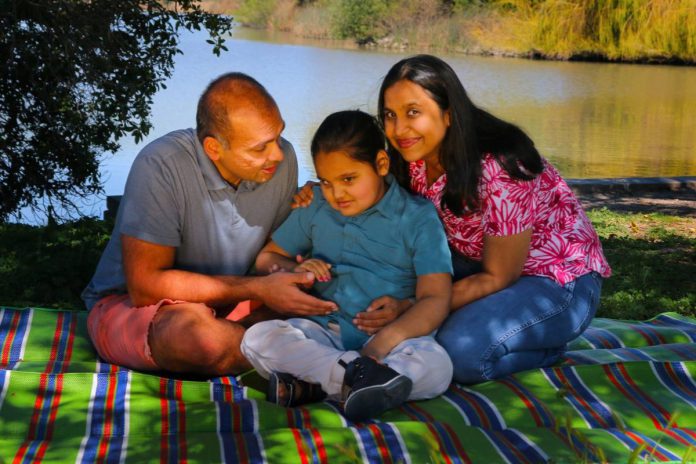
Reyna Jogani, eight-year-old daughter of Jainu and Shruti Jogani, has CDKL5 deficiency disorder, a rare genetic condition that prevents the creation of proteins necessary for optimal neural functioning.
As a result, Reyna’s access to her motor functions has boundaries and control of her limbs comes with effort. However, Reyna’s life is not defined by limits. Her sweetness, sense of humor, imagination and curiosity about the world are flowering, fueled by the love and support of not only her adoring parents but a team of dedicated professionals who have become family as much as caregivers.
Shruti gave birth after a full-term normal pregnancy, but after about three weeks, baby Reyna began to have seizures. Because they were unpredictable and short, it was difficult for her parents to document what was happening. Finally, after keeping a camera trained on Reyna for more than 24 hours, they caught the seizures on camera and sent the video to Kaiser.
An EEG confirmed the seizures originated in the brain in a manner similar to epilepsy. Medications were prescribed and the symptoms abated, but only for a few weeks. Only after a full barrage of tests could doctors confirm the CDKL5 deficiency.
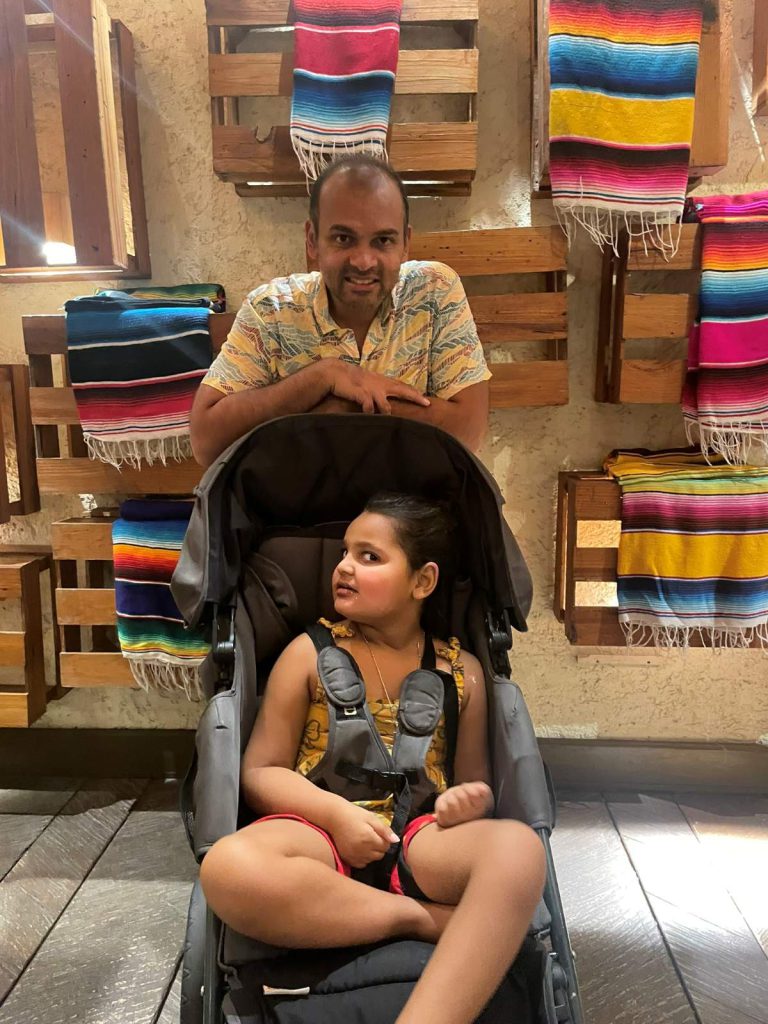
Though physical limitations presented clearly, determining Reyna’s mental state was not as easy. The big question facing her parents was how well she comprehended her world. As it turned out, quite well. Two years ago, she began using an eye-gaze tablet similar to the one used by the late astrophysicist Stephen Hawking. Her eye movements select icons that have specific meanings and they can be sequenced to transmit her thoughts and feelings.
Her communication is nuanced and specific. Her dad goes so far as to say she can be sassy and opinionated. “She can be rather particular,” he says, “and is not above the occasional eye-roll.”
Jainu and Shruti make sure Reyna gets to experience everything an eight-year-old could want. She likes the ocean, playing Uno, listening to Taylor Swift and watching KPop Demon Hunters. Aided by adaptive gear, she has been skiing, boating and horseback riding. Her academic interests include biology and anatomy. She has very specifically, says Shruti, “said she wants to become a lung doctor.”
Jainu and Shruti are of course not alone. A number of individuals care for Reyna’s physical health, social relations and intellectual growth. Her primary care pediatrician, Dr. Faeza Khan, came to Kaiser in 2017, just over a year out of her University of Missouri residency. Only weeks after arriving in California she met the two-month-old Reyna and has been with the family ever since.
Khan was drawn to pediatrics during her university studies. “When I think about the incredible physiology that’s happening in the early years,” says Khan, “the amount of brain plasticity, what a baby is learning right from the first days, it’s amazing. I think about the incredible amount of exploring and joy that a baby experiences, and I love being part of that.”
CDKL5 deficiency is rare, and Khan had to fast track her understanding. Much of what is known is recently discovered and rapidly developing. Reyna’s parents were eager to provide Khan with everything they were turning up in their own research.
“We’ve always felt like a team,” says Khan.
Gaining expertise in Reyna’s condition has aided her in referring the family to various specialists, including neurologists, dieticians, physical therapists and others. “I really credit Jainu and Shruti. For the next patient with a similar diagnosis or genetic condition, I’m going to have my roadmap ready.”
One such specialist, Pam Chapin from Lighthouse Little Learners, has been working with Reyna and her vision challenges for nearly two years. She wants to know accurately the quality of Reyna’s vision, how to best develop it, and how her other senses are supporting it.
Because the difference in Reyna’s vision is neural in nature, simply applying the right glasses isn’t the answer. Therefore, Chapin works closely with Reyna’s parents to determine how she uses a combination of eyesight, touch and hearing in both learning and communicating. With this knowledge, updates to Reyna’s eye-gaze tablet can accurately reflect the growth and changes in her vision-related activity.
“The Joganis are a very motivated family,” says Chapin, “and they’re very good at building a community around her.”
A dynamic member of that community is Reyna’s home tutor, Annemarie McHugh—“Miss Annie” to the family. McHugh comes from the Fremont School District and is a specialist in home instruction designed for kids who, for medical reasons, are unable to attend school. She has been with Reyna for about four years. “When we started,” says McHugh, “it was difficult to know what she was understanding.”
“She could subtly gesture with her eyes,” says McHugh, “but the real breakthrough came the day I asked her to simply pick out the bigger fish in a kids’ book. ‘Is this the bigger one,’ I asked, and Reyna gently nodded yes.” After that, “I started to see she was understanding letters and numbers.”
The tablet Reyna now uses has made all the difference. “She will bring up topics we didn’t even realize were part of the icon set,” says McHugh. “Last year, we were even able to produce a science project.” McHugh adheres closely to a standard curriculum, but she and Reyna’s parents also work together to expose Reyna to a wider array of topics. “We are happy to investigate whatever she’s interested in.”
It’s not all teachers and doctors, however. Nyesha Bahl, a 14-year-old student from American High has begun her own “big sister” relationship with Reyna. Bahl, a neighbor of the Joganis, was inspired to partner with Reyna out of her experience with a family member with cerebral palsy and her volunteer work at Saanidhaanam in India and Friends of Children with Special Needs.
“My goal is just to have fun with her,” she says.
At the beginning Bahl admits she was “playing it by ear” as she got to know Reyna, but, “our activities are becoming more focused. I work with her parents to come up with things that are exciting and fun.”
Reyna’s future is bright. Current work in gene therapy holds promise and the people around her love her and, though focused on her growth, are also just happy to be part of her daily life.