

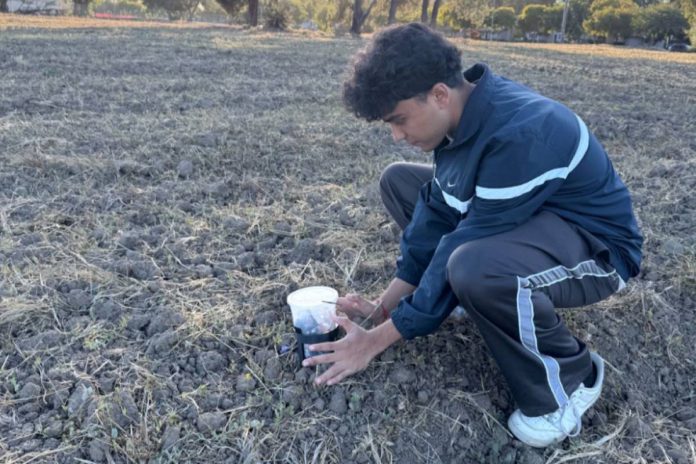
A family trip to Napa in 2024 left a lasting impact on high school students Aksh Parekh and Neev Tamboli. During their visit, they noticed a landscape dominated by “dry yellow hills with barren sand that was as hard as rock.” They met a farmer who shared his struggles to make a living. His crop yields were dropping from season to season due to desertification.
Desertification, which occurs from the loss of nutrient-rich topsoil due to erosion or the death of key microorganisms, is the gradual creation of a drier landscape that can sustain less vegetation than before. Wires on farms held up small quantities of vines—the little green the boys could see. To meet his financial needs, the farmer had resorted to offering tours of the arid farmland.
Moved by the farmer’s story and the landscape they observed in Napa, the high school students reached out to Elizabeth Huffmaster of the City of Fremont’s Environmental Services department and Elaine Owyang, who is president of the local urban garden Local Ecology Agriculture Fremont, to get involved with restoration efforts by developing HydroROOT, a device created to address soil infertility.
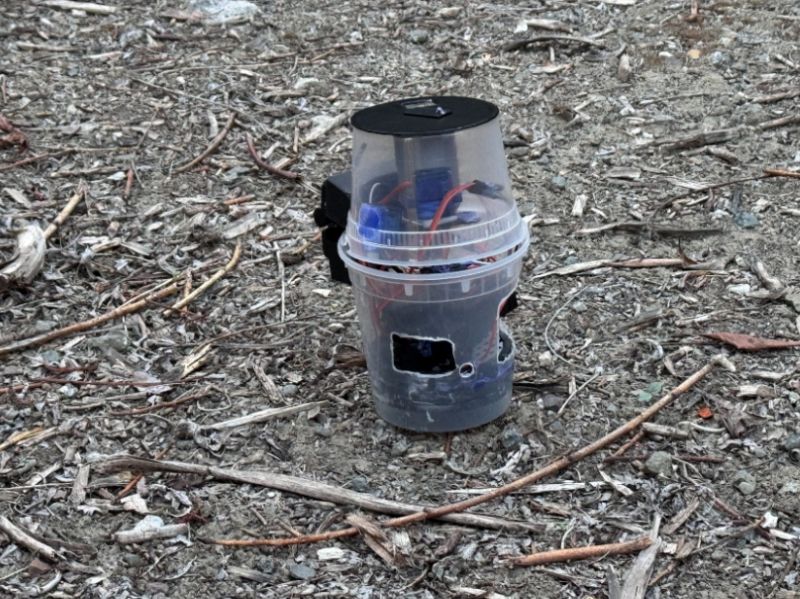
HydroROOT is a two-part device made of plastic fruit containers, microfiber, mulch, polylactic acid (the filament used in 3D printing), hydrogel, wires, and sensors. The premise behind the invention is that deeper soil layers contain more nutrients than surface soil layers since they face less erosion. Using sodium alginate or hydrogel, the HydroROOT pulls water and nutrients up through osmosis.
Both capsules are embedded in the soil. One capsule collects data from the soil and uses a projection computed by artificial intelligence to send instructions to the other capsule, which varies the depth of the hydrogel placement below the soil surface and the method of its dispersion in the form of noodles or blobs.
Through research, Parekh and Tamboli learned that changes to soil pH, moisture, and temperature and the quantities of nitrogen, phosphorus, and potassium play a pivotal role in desertification. The machine-learning algorithm determines the standard for these variables that contributes to healthy soil conditions in that particular landscape or region.
Although the creation of the HydroROOT device was inspired by their conversation with the farmer in Napa, the story of the HydroROOT device originates in Parekh’s and Tamboli’s childhood playing video games. These video games led to their interest in physics, engineering, and computers.
Parekh became interested in artificial intelligence through an internship at a semi-conductor company in 2024. Parekh explains his passion: “Engineering research tied with physics principles inspires me to push through barriers and obstacles and takes me to new spaces.”
Tamboli says that computer science and engineering “create the means to do something else” and have universal application.
Parekh and Tamboli have always loved hiking among, learning about, or admiring the aesthetics of nature. They had thought about environmental issues before their trip to Napa, but the farmer’s story personalized the environmental crisis as something growing more prevalent and for them to focus on.
Parekh and Tamboli experienced challenges in creating the HydroROOT device out of more ecologically-compatible materials at lower costs and determining the mathematical model to use for generating projections. The cradles of the HydroROOT device are currently plastic since the cradles composed by the three-dimensional printer using polylactic acid were too fragile. The high schoolers are trying to develop functional cradles out of wood.
Initially, Parekh and Tamboli spent fifty dollars creating each HydroROOT device. Creating enough HydroROOT devices to have a substantial impact on a large tract of land would have taken an exorbitant amount of money that farmers who are already struggling financially would not be able to afford.
To cut costs, the students created at least fifteen HydroROOT devices in bulk. They also removed the electrical system from each HydroROOT device and developed an electrical system that can operate multiple HydroROOT devices simultaneously. Through centralization and scaling up production, Parekh and Tamboli managed to drop the cost to six dollars per HydroROOT device.
The high school seniors used a mathematical model called exponential smoothing to create a weather forecast on which to base the HydroROOT device’s calculations. Exponential smoothing involves using past models and attaching different weights to each model. The issue with exponential smoothing is that projections are based on the past, and even models compatible with past phenomena may not be applicable for the present or the future.
Challenges aside, the HydroROOT device won won first place in the Plant, Environmental, and Agricultural Sciences category of the Alameda County Science and Engineering Fair at Chabot College in March 2025 and fourth place in the Environmental Engineering category of the Regeneron International Science and Engineering Fair at Columbus, Ohio in May 2025. The international competition included participants from over seventy countries.
Five to seven teams were from Alameda County, but Parekh and Tamboli did not know any of the other participants. Topics were so varied and complex that the judges had to receive education on a variety of subjects in preparation for the event.
Parekh and Tamboli in collaboration with the City of Fremont applied the HydroROOT device to address the soil health of over 80,000 square feet of land, increasing moisture levels in some areas by over five times the initial levels.
The high school seniors aim to publicize the HydroROOT device for use in a variety of regions. They wish to inspire others through stories like theirs. They want to educate people as young as kids attending elementary school so that people care more about nature and have hope to address environmental issues. As they see it, “everyone has responsibility.”