

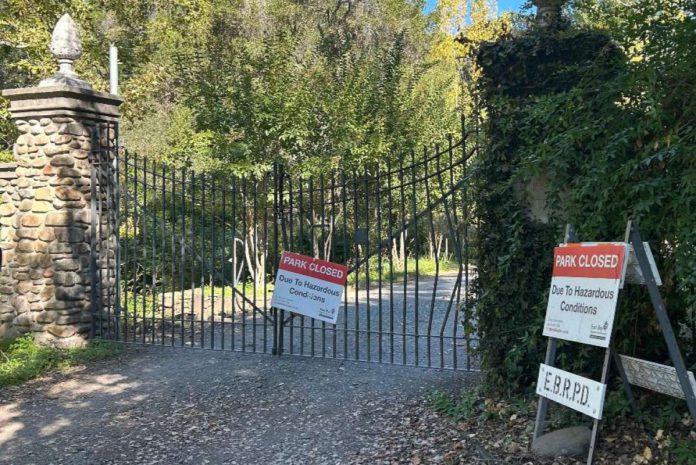
Dry Creek Cottage and Gardens, part of the East Bay Regional Park District (EBRPD), opened to the public in September 2007. Located at 550 May Rd., at the intersection of Whipple Road and Mission Boulevard, Dry Creek Pioneer Regional Park is interconnected with Garin Regional Park, as the two join together where Union City and Hayward meet.
While Dry Creek Pioneer is quite massive in size, with year-round hiking trails and a seasonal iris garden above the parking lot, the true gem of the park is the near-hidden garden refuge where May Road dead ends at the hills—there lie Dry Creek Cottage and Gardens.
This beautiful two-acre garden was legally gifted (along with 1200 additional acres) to the EBRPD in 1978, with the formal land exchange for the garden occurring in 1994-95.
The history of the park is extensive; a brief summary will be given here. For 110 years, the land remained in the hands of one family through three generations. In 1884, August May Sr. purchased the Decoto property. There he established Dry Creek Ranch, the land and cattle counterpart to his butchery business in Alvarado. August and his wife Sophia lived in Alvarado, with August traveling daily to his ranch holdings. Together they had four children: George, August Jr., Henry and Bertha.
In 1900, after August’s passing, Sophia transferred ownership of the property to her daughter, Bertha. Bertha married an architect from Livermore named Henry Haight Meyers, and they settled in Alameda. Together they had three daughters: Edith, Mildred and Jeanette, who were their pride and joy. Henry became a prominent figure in Alameda County architecture, and he designed the Dry Creek cottage for his in-laws.
The cottage functioned as a summer home for the Mays living in Alvarado, and later the Meyers’ who were living in Alameda. The Meyers sisters graduated from Berkeley—Edith became a pediatrician, Mildred an architect and Jeanette a gardener. None of the women ever married or had children. For the entirety of their lives, Dry Creek was a place of rest, and a second home.
In 1935, Henry deeded the property to his three daughters, and until their deaths in 1972 (Edith) and 1982 (Mildred), the sisters spent half of each year living at the property. Before she passed away in 1993, Jeanette continued to care for the gardens weekly. It is she who is credited with much of the planning and design of the original gardens surrounding the home.
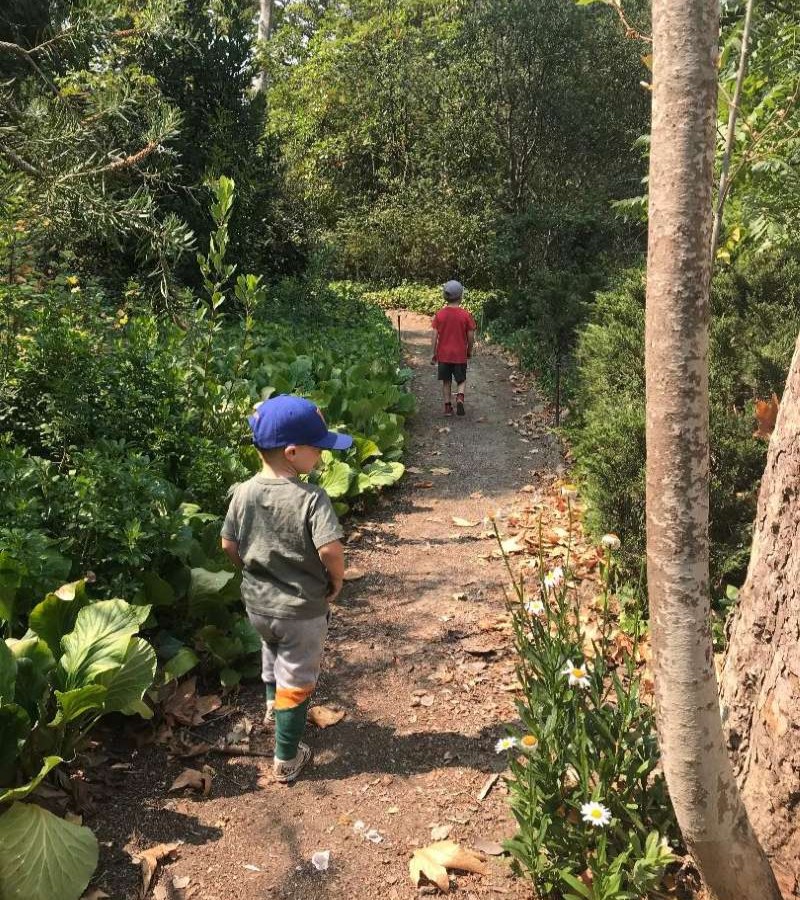
Prior to the May-Meyers Family acquisition, the land was owned by Jonas Clark, a property speculator who lived in San Francisco. He leased the land for cattle grazing from 1863-1884 and established Dry Creek Picnic Grounds. Visitors came from all over the Bay Area, with many arriving by train at Decoto Station.
Clark had purchased the land from Jose de Jesus Vallejo, who in his debt-ridden years was forced to sell off much of his land, which had encompassed Rancho Arroyo de la Alameda.
The land had been granted to Vallejo in 1842, when the ex-Spanish owned Mission San Jose lands were divided into large Mexican ranchos. This was the time of the vaqueros. Prior to this, the land was under control of the Country of Spain. Prior to Spanish colonization, the land in and around Dry Creek was lived on and utilized by the native Ohlone Costanoan people.
Unfortunately, the Meyers Cottage and Dry Creek Garden remain closed to the public due to severe storms during the winter of 2022-23. Major updates are needed to repair a bridge, wildlife barriers and garden beds, with replanting needed as well. The East Bay Regional Park District has submitted requests to FEMA for funding, which are under review and still pending.
Three years have elapsed since the park closed for repairs, with no impending reopening date. Why people aren’t pounding at the stone and iron gates, insisting that the district prioritize this project can only be speculated upon. Perhaps it’s because the garden itself is tucked away. Despite the park’s unpretentious air, Dry Creek Cottage and Gardens need the public’s attention.
When a freeway was proposed to cut through the garden, the sisters fought hard to retain their property. According to the April 15, 1961 edition of the Oakland Tribune, the ladies “refused fabulous sums of money so as to keep [their] land intact for the use someday by all the people.”
Later, Russell A. Beatty, a landscape architect, wrote a 1996 report on the estate, noting, “[There are so many] unique qualities of Dry Creek which, when added together, create a compelling tally of significant values that not only warrant, but demand the careful protection and stewardship of this place for future generations.”
The EBRPD must remember its commitment to the Meyers sisters and the community. It’s time to focus on reopening Dry Creek Cottage and Gardens so that visitors can enjoy it once again.