

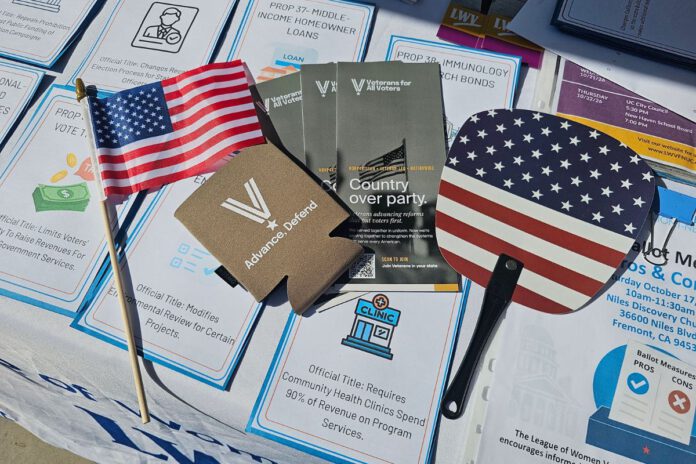
After serving our country in uniform, Veterans for All Voters (VAV) members are continuing their service to our country, moving beyond partisan divisions through their advocacy for greater electoral competition, participation and transparency.
Their areas of focus include advocating for non-partisan primaries, eliminating dark money (anonymous political donations), expanding the citizen’s initiative which allows voters to put proposed laws on the ballot and opposing gerrymandering, which is the practice of politicians drawing voting district lines to make their elections easier to win.
Veterans for All Voters officially launched in Madison, Wisconsin, in October 2021. The idea started in 2018 when co-founder and Navy veteran, Eric Bronner, heard a Freakonomics Radio podcast titled “America’s Hidden Duopoly” that explored how America’s two-party system limits competition and innovation.
Locally, VAV’s California state lead, Navy veteran David Renfro, has been collaborating with other voter organizations on the nonpartisan Trusted Neighbors project. This project educates citizens on how the election process works and combats misinformation through direct human connection. VAV members visit college campuses, veterans’ hospitals, homeless shelters, senior centers and other communities where voter participation has historically been low and/or which tend to have a high veteran population.
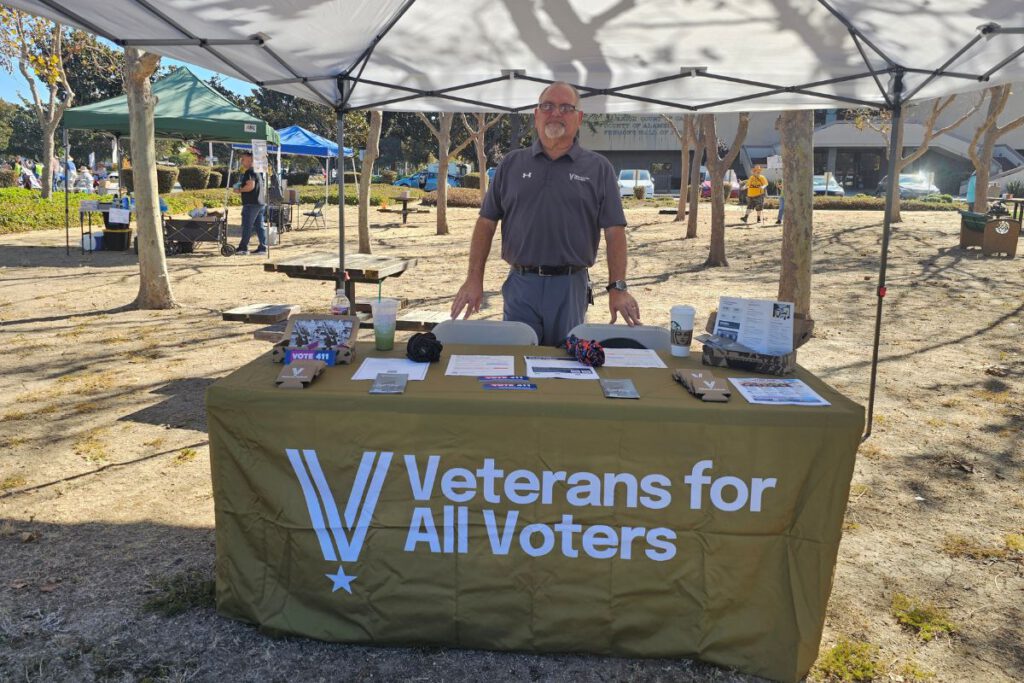
Renfro believes veterans are widely trusted by the public, making them effective messengers in building confidence in the electoral process.
“The goal is to help people understand how elections work and direct them to reliable, nonpartisan information sources, such as the state’s Secretary of State website and VOTE411.org, rather than relying on social media,” said Renfro. “We tell them how to register to vote, let them know the timelines of the election. We explain what to do if they see something suspicious at a poll. How to report it using standard resources, not anything new created by us.”
Renfro says that building trust in elections is especially important for veterans with Post-Traumatic Stress Syndrome (PTSD), who tend to be more skeptical of the electoral system and government leadership in general.
VAV’s longer term goal is to build a more centrist, less polarized voting base. They believe one of the biggest threats to democracy is the broken partisan primary system leaving independent voters out of primary elections. Many veterans are registered as independent voters. VAV advocates for opening primaries to all voters and using reforms like ranked-choice voting. All candidates run in the same primary—in which all voters can participate—and the top finishers advance to the general election.
“It’s not hard for veterans to be nonpartisan, because when you’re in the military, you couldn’t care less what party someone is in,” said Renfro. “They’re going to save your life; you’re going to save their life. I honestly cannot tell you, the folks I worked with in the military, what their political party was. It’s not a thing that you talk about…my best friend is on the completely opposite political side of me. We were both on the same ship, but he’s my best friend and none of that gets between us.”
His words act as a refreshing reminder of what really matters in today’s politically divisive climate.
For more information about VAV go to veteransforallvoters.org.



Thank you for your knowledge and strength!