

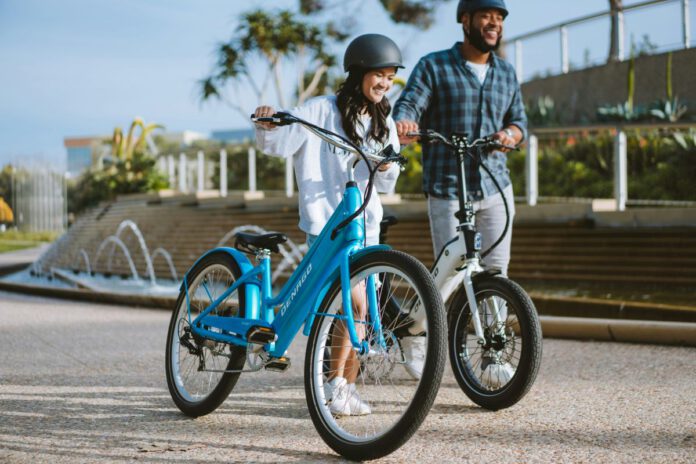
Fall is here and schools are back in session. As thousands of students and parents flood local streets, now may be the perfect time to go over some basic traffic safety rules.
Hopefully this e-bike primer comes in handy…
Rising injury rates
Researchers from U.C. San Diego have found that injuries involving electric bicycles, or e-bikes, have increased dramatically across California, rising from just two reported collisions in 2018 to 1,506 in 2024.
The study (titled: “An Exponential Increase in e-bike Injuries in California”), published on July 17, 2026, in Trauma Surgery and Acute Care Open, also found that e-bike riders were more likely to experience moderate-to-severe injuries than riders of traditional bicycles, highlighting growing public health and safety concerns as e-bike use continues to expand statewide.
“One of our most concerning findings was the disproportionately high number of injured children involved in e-bike crashes,” said John Austin, MD, general surgery resident and research fellow at UC San Diego School of Medicine and first author of the study. “E-bikes provide valuable transportation and recreational benefits, but their higher speeds can generate crash forces more comparable to motorcycles than traditional bicycles, leading to potentially severe injuries.”
Dr. William Moore, who practices sports medicine at Kaiser Permanente Fremont, concurs. He cites a 2026 report by the U.S. Consumer Product Safety Commission (CPSC) which notes that there were 500 fatalities and nearly 700,000 injuries from micromobility devices (including e-scooters, hoverboards and e-bikes) treated in emergency departments across the United States between 2017 to 2024. “We’re definitely seeing more fractures with young people,” he explains.
The American Academy of Orthopaedic Surgeons also warns that the most common e-bike injuries are fractures from falling, and there are higher rates of vehicle-induced collisions with e-bike/scooters versus traditional bikes. More than 10% of injured riders require hospitalization.
What is an “e-bike”?
An “electric bicycle,” commonly referred to as an e-bike, is defined by the California State Vehicle Code as any “bicycle equipped with fully operable pedals and an electric motor of less than 750 watts.”
The motor provides assistance when the rider is pedaling, up to a certain speed.
There are three classes of e-bikes:
Class 1: pedal assist up to 20mph
Class 2: independent throttle assist up to 20mph
Class 3: pedal assist up to 28mph
No license or registration is required when purchasing an e-bike. Per state law, helmets are required for users under 18 for Class 1 and 2 e-bikes, and for all users of Class 3 e-bikes.
Says Moore, “When advising someone about what type of e-bike to purchase, usually there is talk about the route. What sort of path will they be using? Will it be a crowded sidewalk where you need manual control? That might be a situation for a Class 1 e-bike. Or will you be riding a lot in stop and go traffic? Or for longer distances? Class 2 e-bikes are good for that. Riding in bike lanes next to cars, well, you would want something bigger and more powerful like a Class 3.”
E-bikes are allowed on public streets and designated bike lanes, and should follow the same rules of the road as regular bicycles.
The need for speed
Certainly one of the characteristics of e-bikes that make them so popular amongst the youth is their ability to go fast.
Says Moore, “For kids, there is a very big difference between traveling 20mph in a car and doing the same speed on a bike. It feels much different. That is why wearing a helmet is so important.”
Riders should know the rules of the road and be wary of others. E-bikes can be heavier than regular bikes, so training and practice are essential. Moore suggests going through the same steps that you would take when learning to drive a car. Test it out in an empty parking lot until you become comfortable handling it.
Parental support
Much of e-bike safety for children comes down to parental involvement, support, encouragement and education. It can be a precursor to driving, so learning about watching out and caring for the safety of yourself and others can be an important life lesson, especially for children just starting out in the world. Wearing bright clothing and equipping your e-bike with front and rear lights is also advised.
“It’s mostly common sense,” says Moore. “Announce that you’re coming when approaching someone from behind, don’t try and use your phone while riding, or wear earbuds. Be wary of your surroundings. E-bikes are not evil, but we all need to learn to use them responsibly.”
Parents should do their research when purchasing an e-bike, and be wary of retailers selling e-bikes with modified motors that can exceed the legal speed.
For more information, check out the guidelines from Fremont Police Department: fremontpolice.gov/about-us/patrol-division/traffic-unit/traffic-safety/electric-bike-e-bike-scooter-and-motorcycle-laws.



“What sort of path will they be using? Will it be a crowded sidewalk where you need manual control?”
How about, stay off the sidewalk altogether?