

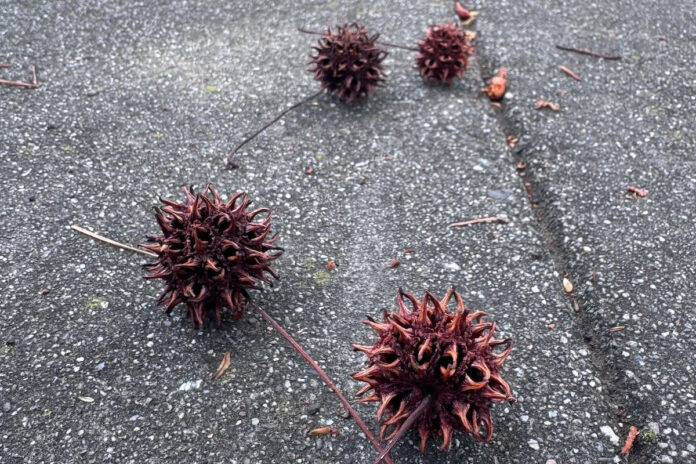
I walk by a row of sweetgum trees on my way to work in Fremont. This time of year, the sidewalk is still scattered with their spiky seed pods—small, medieval-looking hazards that drop in late fall but stubbornly linger well into spring.
Sometimes, when I’m in a mood, I try to kick one. Because they weigh almost nothing, it’s never as satisfying as I imagine. Occasionally, I feel like Charlie Brown, running up to kick the football, only to have Lucy van Pelt yank it away at the last second. The result is less triumph than quiet humiliation—plus a vague concern that someone just watched me punt at a seed pod.
Modern life offers no shortage of similar moments. Small frustrations, low-grade disappointments, the sense that things could—and should—be better. And then there’s the larger backdrop: rising costs, climate anxiety, distant wars, and a political landscape that often feels less like governance and more like brinkmanship.
So where does that leave spring?
Because it is here, whether we feel ready for it or not. The light lingers a little longer each evening. People are back outside—walking, talking, reclaiming small routines that winter interrupts but never fully erases. At Lake Elizabeth, the path fills again with joggers, stroller brigades and determined cyclists. The ducks carry on like nothing is wrong.
The same trees dropping those spiky nuisances are also pushing out fresh green leaves, doing exactly what they’re meant to do: making more trees. It’s hard to argue with that kind of optimism.
Maybe hope, at least locally, isn’t a sweeping feeling. Maybe it’s just noticing that something new is growing in the exact place where something old is still falling apart.
And to me, that’s what spring offers—not a clean slate, but a stubborn insistence. Growth doesn’t wait for perfect conditions. It happens anyway, unevenly, inconveniently, sometimes comically. Even a badly missed kick can remind us we’re still here, still trying.
Which, at this time of year, might be enough.