

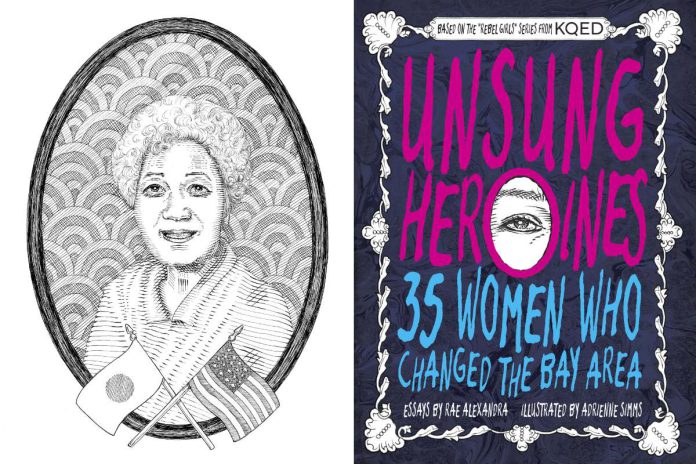
During Women’s History Month, we celebrate women who have shaped our world—many whose names have finally become familiar. But as award-winning KQED journalist Rae Alexandra notes in her new book Unsung Heroines: 35 Women Who Changed the Bay Area, many others have yet to receive their due.
In San Francisco, only about 13% of street names, statues, parks and public artworks honor women. Alexandra decided to respond the way she knew best: by writing them back into history. One of those women has direct ties to the Tri-Cities area.
Tsuyako “Sox” Kitashima was born in Hayward in 1918, the fifth of six children of Masajiro and Yumi Kataoka, immigrants from Japan. After losing their San Francisco restaurant in the 1906 earthquake, the family turned to farming—first in Niles and later in Centerville—growing strawberries until World War II.
Everything changed in 1942, three months after President Franklin D. Roosevelt signed Executive Order 9066. Like 120,000 other Japanese Americans, the Kataoka family was forcibly removed from their home. At the Tanforan racetrack in San Bruno, they were housed in converted horse stables. For Tsuyako, then 23, the humiliation of sleeping in a stall—after the family had been forced to sell most of their belongings and euthanize their dog—was unforgettable.
Soon the family was transferred to the Topaz incarceration camp in Utah. There, Alexandra writes, Tsuyako “evolved into a force to be reckoned with.” She became an assistant block manager and served as a liaison between residents and government officials, advocating for better conditions throughout the three years she was imprisoned.
After the war, Tsuyako returned to the Bay Area and continued a lifetime of service. She worked for the War Relocation Authority and the San Francisco Veterans Administration, and later volunteered with community organizations including Kimochi Inc. in Japantown.
Her activism reached a national stage when she became a spokesperson for the National Coalition for Redress and Reparations, lobbying Congress and organizing letter-writing campaigns—once mailing more than 8,000 letters to President Ronald Reagan and lawmakers.
Their efforts helped lead to the Civil Liberties Act of 1988, which formally apologized for the incarceration and provided reparations to survivors.
Alexandra’s book—adapted from her long-running KQED series Rebel Girls from Bay Area History and illustrated by Adrienne Simms—will be published March 17 by City Lights Booksellers & Publishers. Stories like Tsuyako Kitashima’s remind us that history is not fixed. Sometimes it simply needs to be told.