

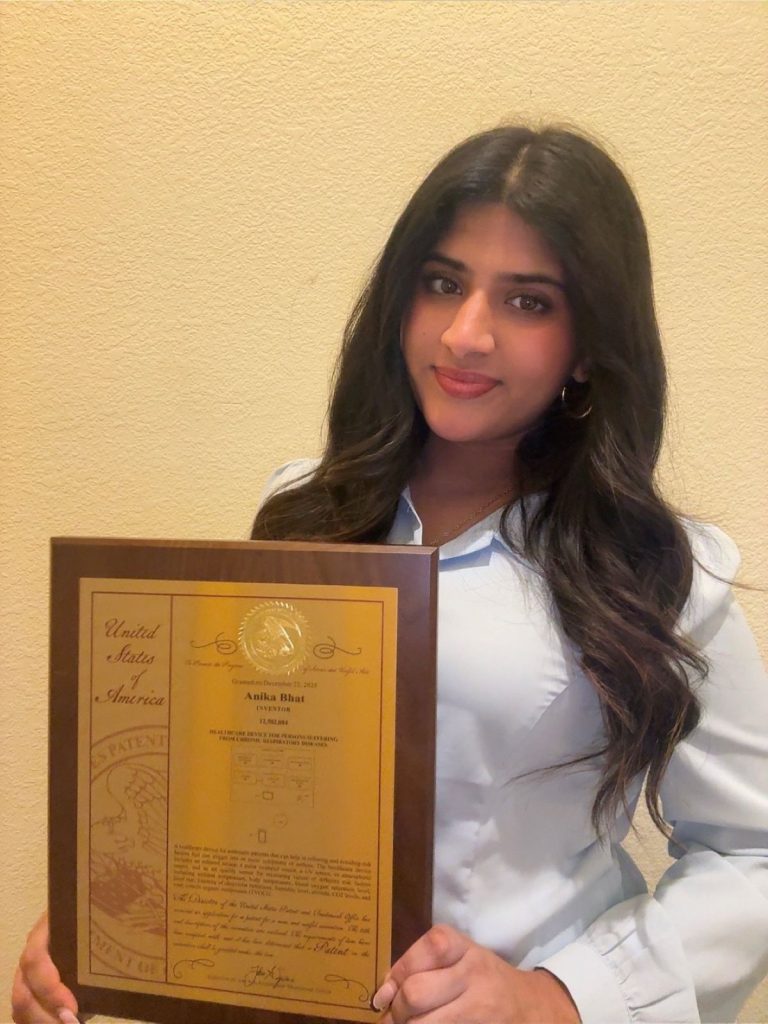
“If you put your mind to it, you can create work that matters,” said Anika Bhat. “And you can become the kind of person who inspires others to do the same.” It’s this mindset that motivated the 17-year-old Moreau Catholic High School senior through the rigorous process of inventing a portable electronic asthma monitoring device. She recently received a U.S. utility patent for it.
Being passionate about finding solutions to real-world problems at a young age, Bhat has taken part in research projects as early as fourth grade at Stratford School. There, she built a homemade kit to determine the electrolyte components of various sports beverages for her school’s science fair.
Ever since then, she’s been conducting both independent and collaborative STEM research and sharing her work through science fairs and publications. Projects included developing a mobile app that scans and flags products for direct and cross-reactive allergen triggers and a prototype to produce renewable electricity from household waste using a microbial fuel cell.
Thanks to projects such as these, Bhat obtained work as a paid intern at the Chabot Space and Science Center in Oakland. She also completed two competitive summer internships at the NASA Ames Research Center, where she worked as the only high school intern alongside skilled scientists and college students.
Throughout her school life, Bhat gained multiple experiences that allowed her to conduct valuable research within healthcare, food security and sustainability by integrating computer and aerospace engineering, robotics and AI.
“Being quarantined alone in my room for two weeks at age 11 during the Covid lockdown, and having to manage multiple medications on my own, made me realize how difficult it must be for people who don’t have support taking care of their health,” Bhat said. “As someone with asthma, that experience pushed me to turn a personal challenge into a solution, which is what inspired me to build a medical device, MEDeBuddy, designed to help chronic asthma patients to self-manage their health.”
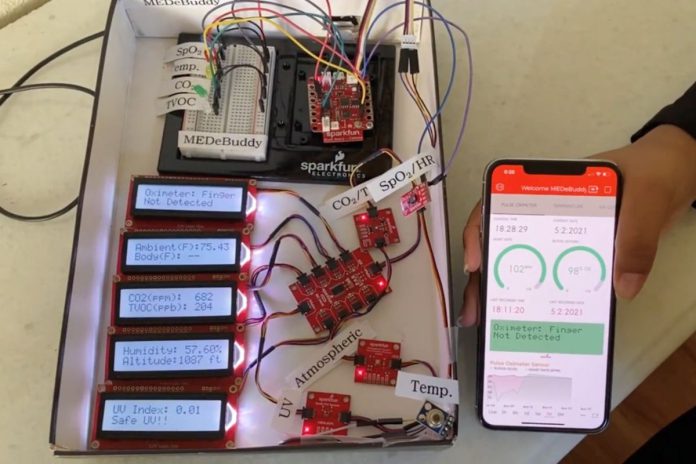
Starting in 2021, Bhat worked on MEDeBuddy, a comprehensive real-time health and environmental monitoring system specifically engineered to help asthma patients prevent further attacks and manage their condition more effectively. Alongside a smartphone app, the device uses sensors to track multiple parameters, from internal vital signs like blood oxygen levels and heart rate, to external environmental triggers such as carbon dioxide and humidity levels.
Bhat has also proved her device’s capabilities work with real patients, including her grandparents, by attaining accurate and consistent results when she took it with her to India. Within its first year, MEDeBuddy won the first place Grand Award and became a Broadcom MASTERS 2021 nominee at the Synopsys Alameda County Science & Engineering Fair (ACSEF), and earned first place at the California Science & Engineering Fair (CSEF), along with additional awards.
According to Bhat, multiple rounds involved the United States Patent & Trademark Office (USPTO) examiner sending questions and “prior art” about existing patents or publications. Bhat had to study them carefully to explain how her device was different. On top of that, the process took years to reach a definite conclusion, and whatever money she received from awards through science fairs were used to fund the patent process. The patent for Bhat’s device was officially granted on Dec. 23, 2025.
“The recent official grant of the patent felt like the best confirmation that persistence matters,” said Bhat. “There are so many paths into STEM—what matters most is taking the first step, staying consistent and finding people who will encourage you along the way.”
Using her experiences with MEDeBuddy as a starting point, Bhat aims to continue refining the device’s design, making it more reliable and accessible for others to use. Through research, partnerships, testing and community trust, she hopes to become both an engineer and an entrepreneur who invents new technology that helps shape responsible integration into everyday life.
More information about Anika Bhat’s patent can be viewed at patents.google.com with further research at thinkmind.org.