

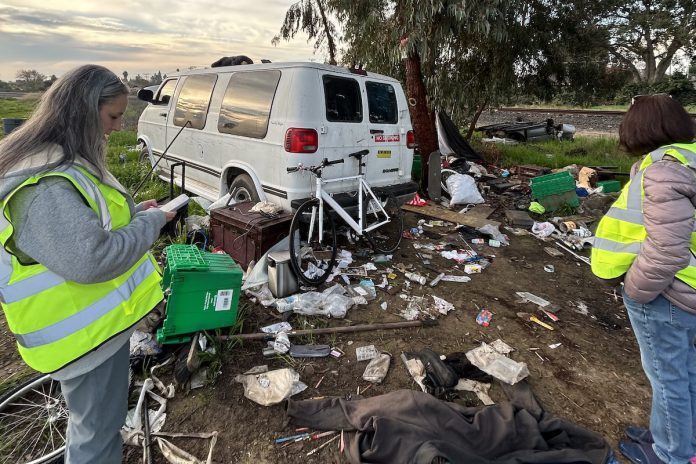
Local leaders are feeling hopeful about this year’s homelessness point-in-time (PIT) Count, which took place on Jan. 22 in Alameda County.
The county’s health department said 2024’s PIT Count showed that overall, homelessness (including those in emergency shelters and transitional housing) dropped by 3%. The number of unsheltered residents (living in places not intended for habitation such as in cars or on the streets) decreased by 11% over the same period.
The people counted included those living in emergency shelters, transitional housing and who are unsheltered, mainly outdoors in cars, on streets and in parks. More than 1,200 volunteers are expected to have participated in this year’s PIT Count. The government’s Housing and Urban Development (HUD) mandates that the count is done every other year.
The PIT Count is a snapshot of the county’s homelessness population. Jonathan Russell is director of Alameda County Health Housing and Homelessness Services. He said via email that the count is organized by location, with each location having a lead person. The county then provides the tools, methodology and training to conduct the count.
The PIT Count planning team includes consultants, local government representatives, nonprofit providers and people with lived experience of being unhoused. During the count, volunteers talk to people experiencing homelessness to find out why they were there and what they need to get out of homelessness.
Russell said having the PIT Count is a way to better understand the magnitude of homelessness in the county. It’s also a way to find out where evidence-based and compassionate solutions are most needed.
The count is important this year because federal funding cuts impacted Housing and Urban Development. Russell said the department is expected to lose between $33 to $60 million dollars in annual funding this year.
Measure W funding allocation for the Home Together Plan will hopefully fill the gap in proven homelessness solutions locally. The plan is a county-wide approach to reduce homelessness, focusing on prevention, providing more shelter space and housing, and overall easier system access and coordination between entities.
The board of supervisors allocated 80% of Measure W annual tax revenue towards the Home Together Plan in July 2025. Measure W came from a 2020 county sales tax ballot measure for general revenue, which explicitly stated the money would go towards homelessness and other essential county services.