

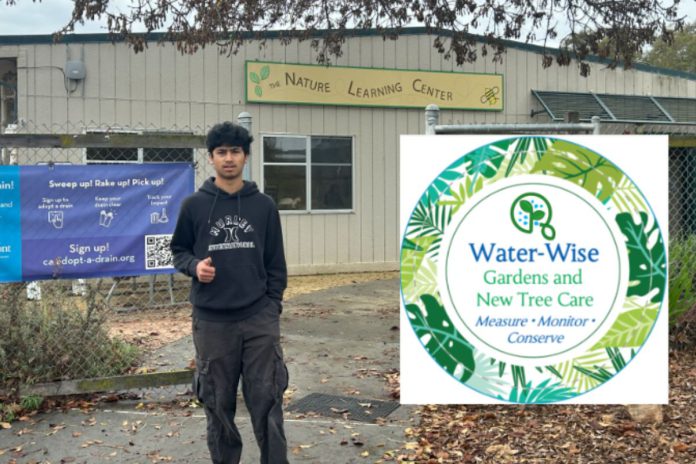
Less than one percent of the Earth’s water is freshwater, and nearly 70 percent of it is used for irrigation. Growing up in California, where drought conditions remain an ongoing challenge, made me realize early on the necessity of conserving water.
Inspired by Fremont’s environmental sustainability goals under the platform My Climate Ready Fremont, I began my Eagle Scout service project focused on developing a data-driven approach to irrigation. This work later evolved into a broader initiative I now call “Water-Wise Gardens and New Tree Care.”
My work began at LEAF (Local Ecology and Agriculture Fremont), where I led a team of Scouts to design and build a community garden bed from the ground up. I installed soil-moisture sensors connected to a microcontroller to monitor daily moisture levels and collected data over time. Using this data, I trained a machine-learning model to generate irrigation recommendations based on real-time soil conditions and environmental factors.
Through this approach, the project demonstrated nearly 36 percent water savings compared to traditional timer-based irrigation systems.
Building on this foundation, I developed AquaNeer, a Smart Irrigation Assistant designed to help community and school garden teams better understand when and how much to water. AquaNeer factors in plant type, soil conditions, plant growth stage and environmental data to provide clear irrigation guidance. The app was recently selected as a finalist in the 2025 Congressional App Challenge, recognizing its real-world relevance and innovation.
As part of the Water-Wise Gardens and New Tree Care initiative, I expanded my efforts to support schools in the Fremont Unified School District, where newly planted trees were struggling due to over- or under-irrigation.
In response, I created and distributed Water-Wise Gardens and New Tree Care educational kits to multiple schools and conducted hands-on educational and demonstration sessions for students and staff. These sessions focused on understanding soil moisture and irrigation needs, particularly for caring for newly planted trees during their critical early growth period. I plan to continue expanding this work to additional schools in 2026.
I also conducted an educational session at the Nature Learning Center in Fremont, engaging students and community members in discussions about water-wise gardening and sustainable irrigation practices. Additional educational sessions are planned in 2026 to further build awareness and provide hands-on learning opportunities around water conservation.
Looking ahead, my goal is to evolve AquaNeer into a fully integrated and autonomous smart irrigation solution that can support schools and community gardens at scale. Through this journey, I have learned that technology and data can play an important role in promoting environmental stewardship and can be scaled to help protect our natural resources—beginning humbly with one garden and one new tree at a time.



WOW! What a valuable, noteworthy project to teach and distribute kits about irrigation to nourishes trees by neither over watering nor under watering–and conserve precious water.