

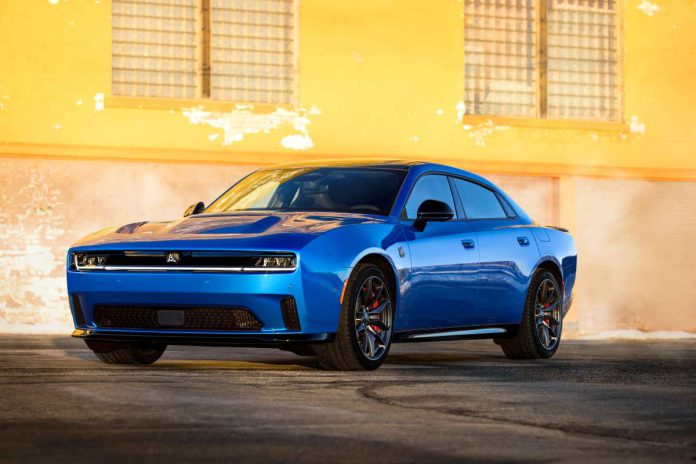
The Dodge Charger Daytona Scat Pack Track Package is a noisy, tire-shredding contradiction. It’s a mouthful of a name, but it sums up what this electric muscle car is all about. Performance is job one. Surprisingly, even though it can scat like a race car, it’s also a functional four-door sedan you could drive every day effortlessly.
As EVs have proliferated, and the Dodge brand is somewhat late to the party, the Stellantis brand decided to stick with a familiar image. Dodge has been crafting its performance image with Hemis and Hellcats, so orienting its new EVs to the brand image is not a stretch. After all, an electric car has instant torque delivered from launch. With all-wheel drive (standard on all Dodge EVs), it’s a no-brainer to put that torque directly to the pavement.
The high-end version of the Daytona EV we drove has dual motors creating 670 horsepower (hp) and 627 foot-pounds of torque, more than enough to swiftly move the 6,000+-pound vehicle. In addition to that torque being available at launch, or for passing on the freeway, this model also has an extra 40 hp available at the push of the boost button.
Dodge has clocked the Scat Pack at 3.3 seconds to 60 mph and 11.5 seconds for a quarter mile. Those are all decent numbers that would be respected by the track-oriented crowd, and would smoke some of those muscle cars of 55 years ago. If you go a little light on the throttle, the Daytona will deliver 223 miles of range.
Beyond power
The power was impressive, but on closer inspection this car had even more to offer. For starters, it’s a good-sized four-door sedan with a functional back seat and trunk.
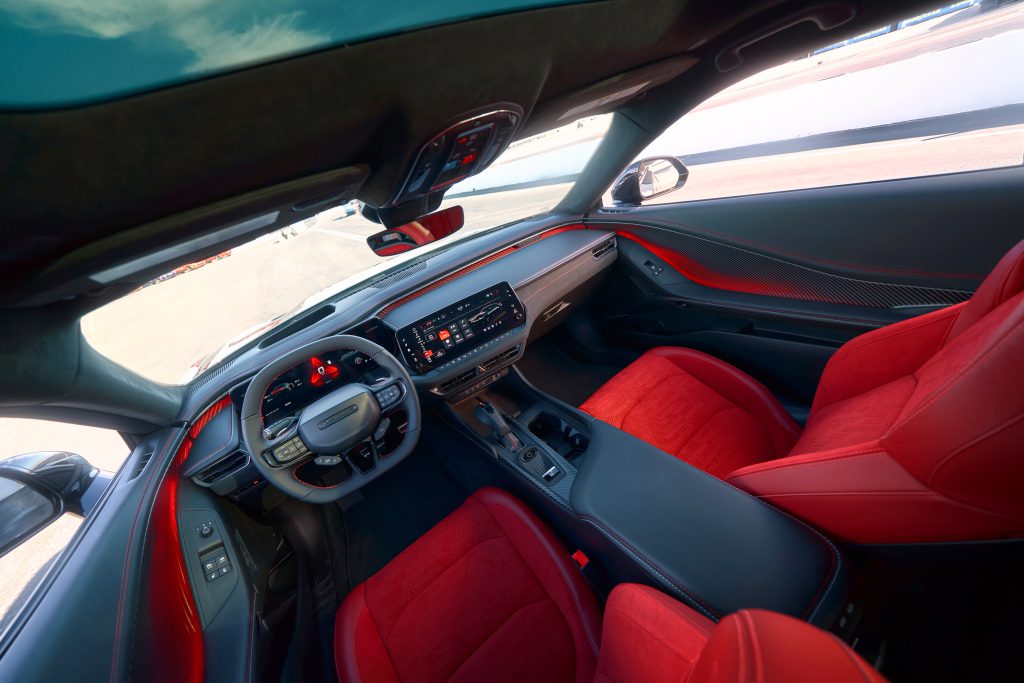
The widebody design that helps with the car’s handling pays dividends inside. There’s plenty of room to stretch out in the (optional) heated and ventilated seats. The Daytona has the usual two-screen setup with a driver having a configurable display that’s augmented by a 12.3-inch center infotainment touchscreen employing Dodge’s easy-to-use Uconnect 5 system.
Then there’s the sound coming from the Fratzonic Chambered Exhaust. The good news—you can turn it off. If your silent electric muscle car somehow leaves you yearning for the good old days of rumbling pipes and dramatic shift sounds, this system will give you that. It’s fun, but most importantly, you can turn it off.
Finally, Dodge believes we have returned to the time of choice. During this coming year, if the Charger interests you, you will have choices. You can get two or four doors, an EV like we drove or one with a twin-turbo 6-cylinder engine that cranks out 550 hp. The price differential between the EV and gas cars is minimal, starting in the high $50-low $60,000 range. The catch, though, is in some of the enticing option packages.
That laundry list of goodies, which included some really fun and valuable items (Brembo brakes, for instance, for performance enthusiasts, as well as suspension tweaks) items, took our $61,995 base price Daytona EV up to $80,455. To be honest, if you’re a little cash-strapped, you will not be disappointed in the base car. But those add-ons did bring value.
Speaking of value, while the federal tax credits are gone from EVs, manufacturers like Dodge are doing their best to make it up with finance and leasing deals that bake in similar savings.