

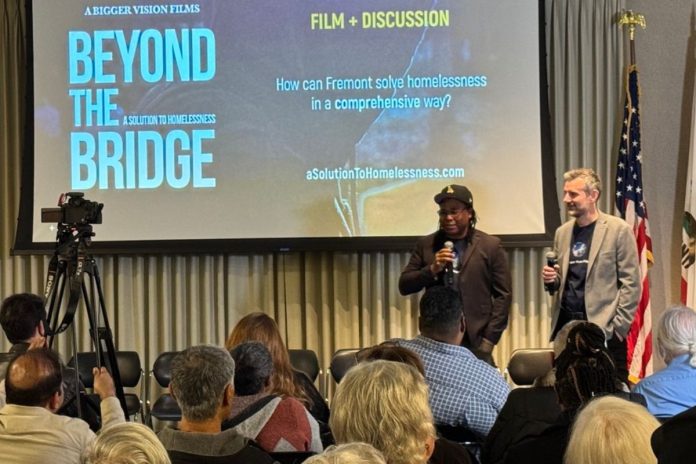
A documentary screening of Beyond the Bridge: A Solution to Homelessness took place at Washington Health’s Anderson Auditorium in Fremont on Nov. 20.
Director Don Sawyer and cinematographer Tim Hashko were at the event to answer questions about their film. Fremont City Councilmember Kathy Kimberlin and United Way of the Bay Area organized the event.
Before the documentary started, Sawyer said to the audience, “Homelessness is happening everywhere. Homelessness is nobody’s fault.”
After the screening a panel of local leaders and elected officials held a discussion. The panel included Alameda County Supervisor of District 2 Elisa Marquez, Alameda County Housing director John Lo, Abode Services CEO Vivian Wan, Washington Health chief inclusion officer Gisela Hernandez, pastor of Niles Discovery Church Jeff Spencer and Niles Main Street Association president Krysten Laine, among others.
[In a Housing First model] an unhoused person gets to live in a home without any requirements to sign up for drug addiction treatment or mental health services. That way, unhoused people can get permanent housing and supportive services when they are ready to receive them.
The documentary is about solutions to homelessness. One is the Housing First model, where an unhoused person gets to live in a home without any requirements to sign up for drug addiction treatment or mental health services. That way, unhoused people can get permanent housing and supportive services when they are ready to receive them.
Producers of the documentary said the main message of their film is that everybody is working together. When talking about the cities that are succeeding with Housing First, Sawyer said, “They involved their entire community, particularly the business community. The business communities, they are systems people. They are civic minded. And if you approach them with a business case, they normally respond.”
Niles Main Street Association president and Niles business owner Krysten Laine said, “I am very ashamed to say that I have been behind some of the encampment clearings in Niles. When you get calls from the community members because there’s tents being built up against their backyards, they’re seeing needles on the streets, they’re seeing garbage everywhere. Kids are afraid, our seniors are afraid.”
Laine said Niles Main Street Association hires unhoused people for the day when they organize events. “They come out of the woodwork because they want to work. And we give them money to help us run these events,whether it’s sitting at the gates to help people get in and out of our events safely, servicing our bathrooms, garbage, setting up booths… giving people directions, they’re a part of the community.” Niles Main Street Association holds 23 events a year.
“Housing First is the good Samaritan and Matthew 25 wrapped into one. It is the most Christ-like intervention you could possibly even dream of.”
– ‘Beyond the bridge’ Director Don Sawyer
Pathways to Services Development founder James Gonzales, a former unhoused person, said, “This whole thing for me, it’s full circle because Housing First works. And a lot of people out there that are unhoused whether you’re talking about Isherwoods or Ardenwood. They really are trying. And there are a lot of barriers.”
Sawyer said, “Housing First is the good Samaritan and Matthew 25 wrapped into one. It is the most Christ-like intervention you could possibly even dream of.” The Bible story he is referring to is about Jesus praising those who fed, took care of, clothed and offered shelter to strangers in need.
Religious organizations working together is reflected in Fremont’s response to homelessness. In a video message played at the event, Mayor Salwan said the city recently added two Safe Parking sites for unhoused people to park their vehicles at St. James Catholic Church and United Methodist Church. He said Fremont’s Housing Navigation Center served nearly 280 people, with 60% moving into stable housing.
Marquez, who represents Hayward, Newark, Union City and parts of Fremont, said Alameda County is investing in solutions to homelessness. County residents passed Measure W several years ago, which will fund the county’s “Home Together Plan.” She said the plan includes $276 million in homelessness prevention, $148 million in rental assistance and $348 million towards shelters. Overall, the county is spending $1.4 billion on solutions to homelessness.
Sawyer said agencies and community leaders working together is the key to solving homelessness. “You have to attack all the stuff, you’ve got prevention going on, you have to keep them from coming in,” he said. “You set a table with health care and law enforcement, elected officials, the mayors, the county.”